
A wooden hot tub heated by a wood-burning stove — an everyday sight in the Baltics and Scandinavia, and a fast-growing trend at cottages and mountain properties across Europe. The answer to the question in the title is: it is both. No technology can replace the ritual of stoking the fire and bathing under the open sky without a single cable — but in exchange you accept slow heating, manual temperature control and more frequent water changes. In this guide we will walk through how a wood-fired tub works, what running one really involves, and when a classic hot tub makes more sense.
What is a wood-fired hot tub and how does it work?
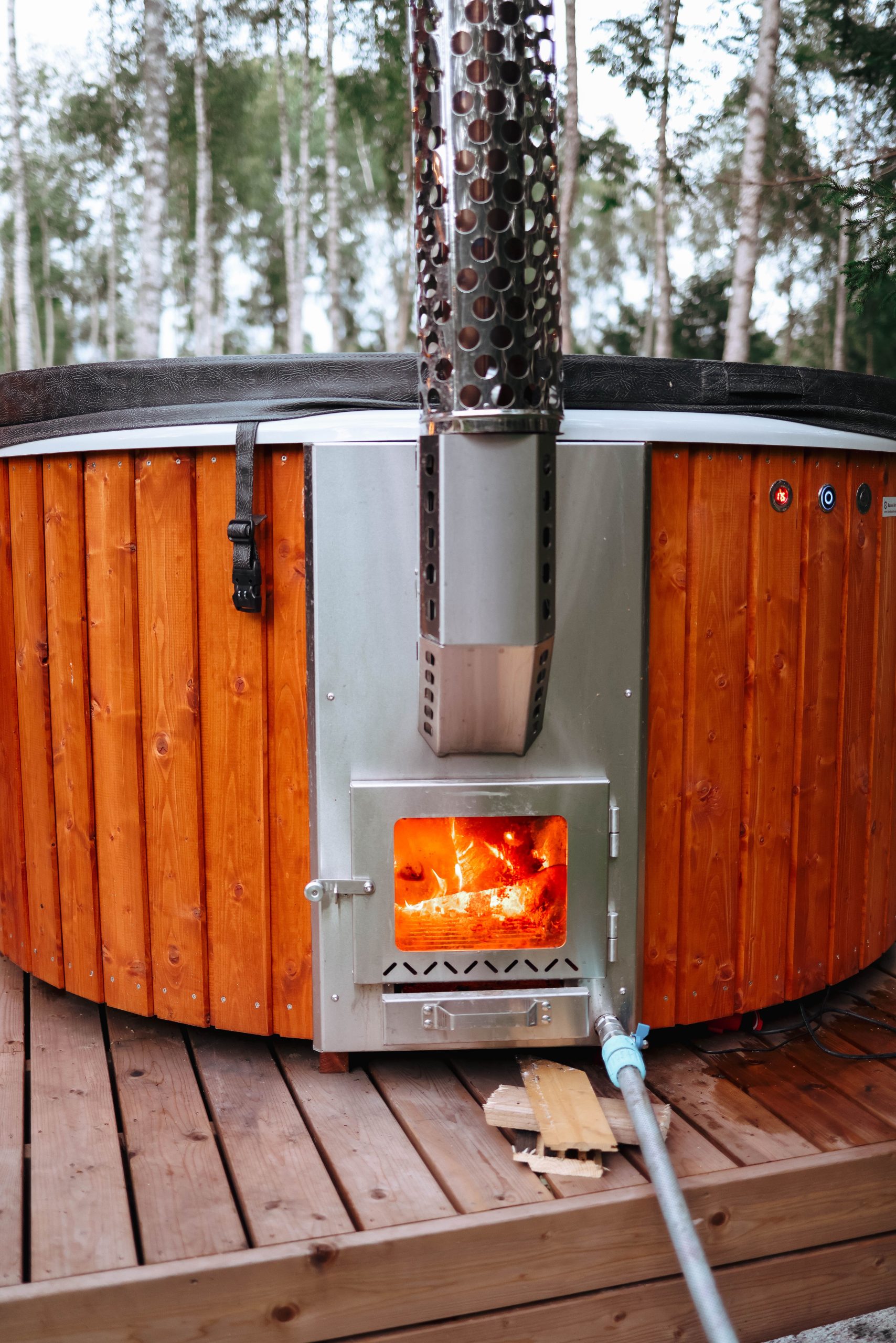
A wood-fired hot tub (also known as a bathing barrel or Nordic tub) is a vessel holding 900 to 1,600 litres of water, heated by a wood-burning stove. No pump, no heating element, no power connection — in its basic form it is a purely mechanical system that works anywhere you can bring water and firewood.
Heating relies on natural convection: cold water flows into the stove through the lower port, the heated water rises and returns to the tub through the upper one. The water circulates on its own, with no electricity. That is exactly why these tubs are popular at cottages, by ponds and on plots without a power connection — unlike a hot tub, which needs a dedicated fused supply (covered in detail in our article on hot tub electrical requirements).
The magic, however, lies mainly in the ritual. Splitting the wood, lighting the fire, feeding it for an hour or two while watching the smoke rise from the chimney — and then sinking into the water after dark, with the fire crackling by your ear and stars overhead. It is the slow, deliberate counterpoint to a hot tub, where you press a button and the jets are massaging you ten seconds later.
How long does heating take and how do you control the temperature?
This is the first big reality check. Manufacturers quote heating from ordinary water temperature to a bathing 37–38 °C in 1.5 to 3 hours — for a tub of around 1,600 l with an integrated stove, sellers typically state roughly 2 hours of firing. In practice, expect more like 2 to 5 hours: it depends on the tub’s volume, the stove’s output (commonly 20–30 kW), the type of wood and above all the starting water temperature. In summer you are heating water from 18–20 °C, in winter from just a few degrees — which can easily double the heating time. Hardwood (beech, oak, birch) burns longer and hotter than spruce.
The second lesson: the temperature cannot be held thermostatically. The stove has no concept of a target temperature — you fire it until the thermometer shows the value you want, then let the fire die down or add wood sparingly. The water also heats unevenly (hot at the top, cool at the bottom), so it needs to be stirred with a paddle before you get in. Overheating the tub is easy; the only quick fix is topping up with cold water. If you want hot water within a few hours without tending a fire, we have written a comparison of how fast different heating methods are.
What about the water? There is no filtration as standard
A basic tub has no filtration and no automatic sanitising. That leaves two options: either change the water after a few baths (with heavy use easily after 2–4 sessions — untreated water lasts a matter of days), or add an external filtration unit or a UV lamp and treat the water with chemicals much like in a hot tub. With a small volume of 1,000–1,600 l, a water change is quick and cheap, yet it is still work that a hot tub with a filtration circuit does for you. Sanitising and testing products can be found in our water treatment category.
Materials: solid wood, or a plastic liner?
On the market you will meet two schools of construction, and the difference is fundamental for both maintenance and lifespan.
An all-wood tub (spruce, Siberian larch, cedar or thermowood) is the authentic classic. Spruce is the cheapest but least durable; larch and cedar naturally resist moisture; thermowood (timber heat-treated at around 214 °C) does not absorb moisture, does not warp, and manufacturers quote a lifespan of up to around 30 years with annual oiling. The catch with an all-wood tub: the timber seals by swelling. After standing empty for a while it dries out and the tub may leak until it has “drunk” its fill again. It therefore demands regular use and care.
A tub with a plastic (polypropylene) or fibreglass liner and a wooden cladding is the pragmatic choice: completely watertight, easy to clean, and tolerant of chemicals and longer periods out of use. Here the wood plays a purely aesthetic and insulating role. Most tubs sold today have a liner — you lose nothing of the authentic look, and the most common source of trouble disappears.
The stove: submersible or external? And where does the chimney go?
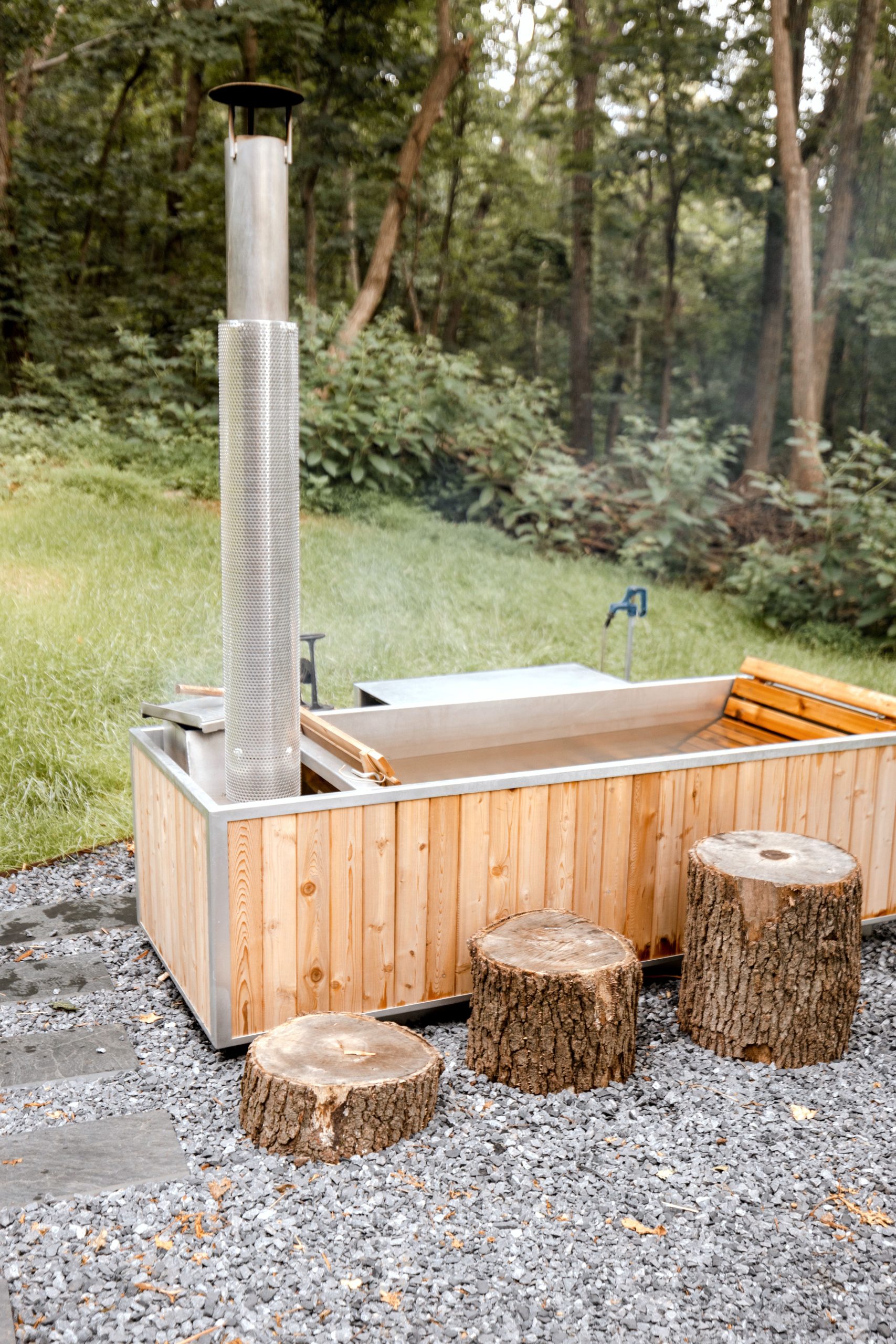
A submersible (integrated) stove hangs directly in the water inside the tub, separated by a wooden screen. It transfers heat most efficiently — heating the water roughly twice as fast as an external stove — but it takes up bathing space, and you feed it from above, over the rim of the tub. An external stove stands beside the tub and connects to it via two ports. You stoke it comfortably through a door, more room is left in the tub, and the stove is easier to clean; the price is slower heating and slightly higher heat losses.
In both cases you have to deal with the chimney and sparks. The stainless steel flue is typically 2 m tall and ends just above the bathers’ heads — the chimney must not be painted and gets very hot in operation. So do not place the tub under low overhanging branches, a pergola made of combustible materials or right against a timber façade; keep a safe clearance of several metres from combustible structures as per the manufacturer’s instructions and use a spark arrestor. Also think about the prevailing wind direction, so the smoke does not drift onto your terrace or towards the neighbours.
The tub in winter: the best experience, the biggest risk
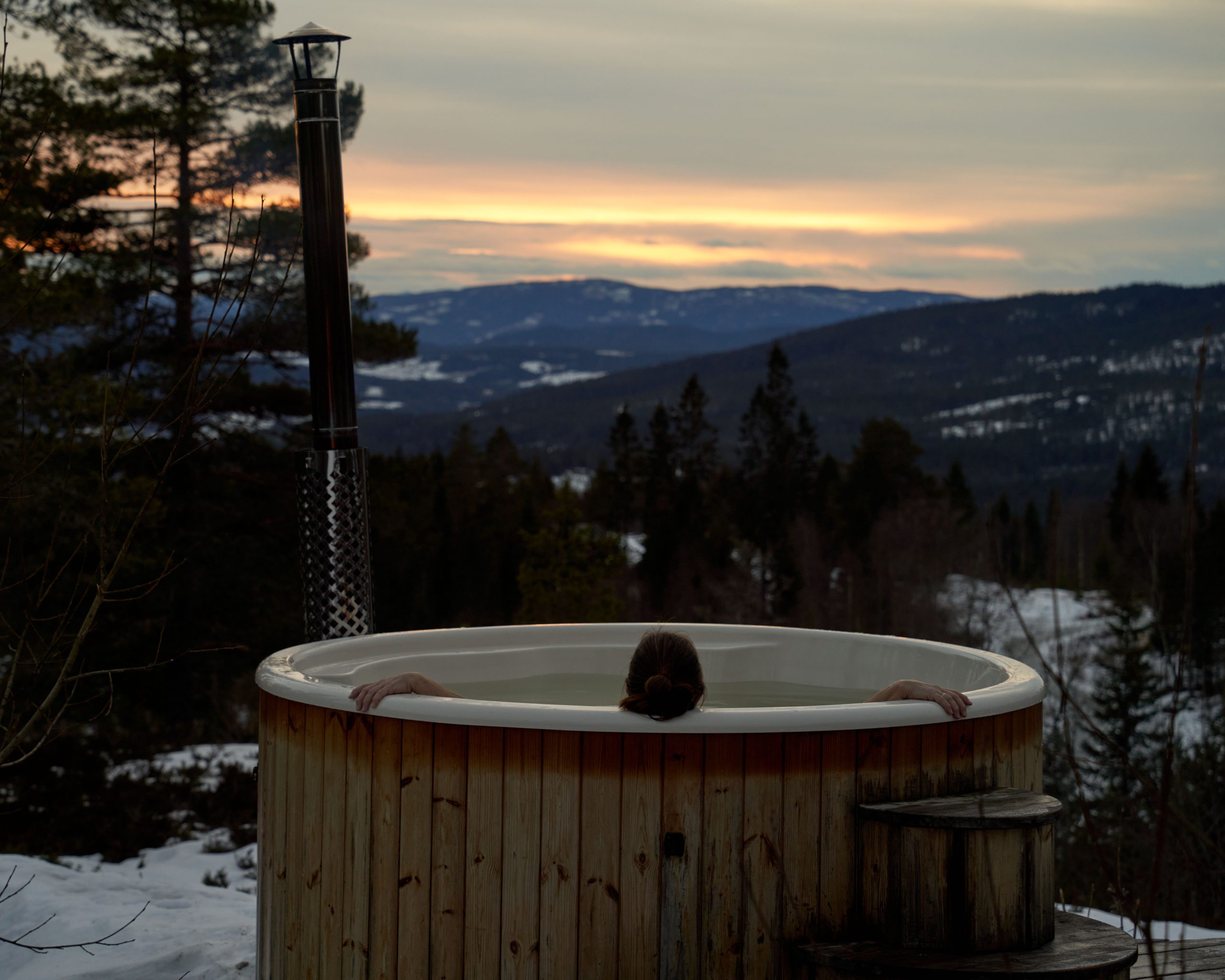
Winter is the peak season for a wood-fired tub. Sitting in 38 °C water while everything around you is frozen and steam rolls over the surface is the experience these tubs are bought for — and a natural gateway to contrast therapy: warm up, dash into the snow, back into the hot water.
There is a hard condition, though: a tub without electricity has no standby heating and no frost protection. Water left in the tub and the stove after a bath can freeze during a frosty night — and ice can split the stove jacket and the pipework. So in winter the rule is: drain after bathing, at the very least the stove and the plumbing. That is a fundamental difference from a hot tub, which in winter is deliberately kept full and temperature-maintained (see running a hot tub in winter).
Wood-fired tub vs. classic hot tub: a comparison
The table below puts a wood-fired tub side by side with a classic acrylic hot tub. Hot tub costs are broken down in detail in our article What it costs to run a hot tub.
| Criterion | Wood-fired hot tub | Classic hot tub |
|---|---|---|
| Purchase price | approx. €3,200–6,000 | approx. €6,000–20,000+ |
| Power connection | none (water + firewood) | 230/400 V electricity, fused circuit |
| Time until you can bathe | 2–5 h of firing before every bath | immediately (water is kept at temperature) |
| Temperature control | manual — stoking, stirring, topping up | thermostat to 0.5 °C |
| Massage | no (air bubble system as an option) | hydromassage jets as standard |
| Filtration and sanitising | none as standard, water change after a few baths | automatic filtration circuit |
| Running costs | firewood (a few euros per bath) + more frequent water changes | electricity approx. €40–100/month depending on the season |
| Winter | a wonderful experience, but drain after bathing | year-round operation with standby heating |
| Maintenance | clearing ash from the stove, oiling the wood | chemicals, filters, servicing the technology |
What does a wood-fired hot tub cost in 2026?
Indicative prices of complete sets (tub + stove + chimney) on the European market in 2026: thermowood tubs with an external stove start at roughly €3,200–3,900, while models with a plastic liner and an integrated stove for 6–8 people come to around €3,900–5,900 depending on the equipment (thermal cover, air bubble system, LED lighting). Simple unheated plunge tubs intended for cold-water bathing can be had from about €1,100. Cheap no-name spruce sets can be found even below that level, but it is precisely these where leaks and a short lifespan are most common.
Add to the price a firm, level base — a full tub weighs 1.5 to 2 tonnes, similar to a hot tub (load-bearing is covered in our article on terrace structural loads) — and possibly filtration or a thermal cover, which dramatically slows the water’s cooling between baths.
Who is the tub for — and who should skip it?
A wood-fired tub makes sense if:
- you have a cottage or a plot without electricity, where a hot tub is out of the question,
- the ritual of firing and preparing the bath is part of the experience for you, not an obstacle,
- you bathe occasionally — at weekends, with guests, after the sauna,
- you want winter bathing and cold exposure with a minimum of technology,
- your budget is up to about €6,000 and low fixed running costs are a priority.
Choose a hot tub instead if:
- you want a bath any time, without waiting or planning,
- you expect hydromassage — a tub is a bath, not a massage,
- you will bathe several times a week (frequent water changes and firing get old),
- you prefer water that is always ready, filtered and chemically treated.
Before you decide, read our guide to choosing a hot tub; and if the low entry price tempts you, we have also compared inflatable and acrylic hot tubs — inflatable models start at a similarly low price to simple tubs, but offer a completely different kind of experience.
Frequently asked questions (FAQ)
How long does the water in the tub stay warm?
Without a cover, the temperature drops by several degrees per hour depending on the weather; with an insulating thermal cover the water holds bathing temperature for several hours, and the next day you reheat it far faster than starting from cold. Overnight in winter, however, you will not hold the temperature without firing.
Can I use chlorine in a wooden tub?
In tubs with a plastic or fibreglass liner, yes — in doses as for a hot tub. With all-wood tubs, consult the manufacturer about chemicals — aggressive sanitisers can damage the wood and its watertightness; gentler options are active-oxygen sanitising or a UV lamp combined with more frequent water changes.
How much firewood does one bath use?
Roughly one to two wheelbarrow loads (about 15–30 kg) of hardwood per heat-up, depending on the tub’s volume, the season and the quality of the wood. Dry hardwood (beech, oak, birch) heats far more efficiently than soft spruce.
Do I need a building permit for a wood-fired tub?
The tub is mobile equipment, not a structure, so usually not. You do, however, need to observe safe chimney clearances from combustible structures, and for a permanent installation it is worth checking local requirements with your municipal authority.
Can the tub be upgraded with massage jets?
Many manufacturers offer an air bubble system as an optional extra — but that already requires electricity for the blower. A tub will never offer the full hydromassage of a hot tub.
Whether you choose the Nordic ritual with its scent of woodsmoke or the comfort of technology, both have their place in the garden — and they often complement each other beautifully, for example a tub as the cooling counterpoint to a sauna. Tubs, saunas and home wellness accessories can be found in our wellness category, and the complete range of hot tubs in the hot tubs category.
