
A pool or hot tub needs surprisingly few things — but you have to own them from day one. A water tester, a net with a telescopic pole, a brush, a vacuum, a thermometer, a starter chemical kit and a cover will handle ninety per cent of routine maintenance. Everything else is either a useful upgrade that deserves to be bought once you have your own experience, or an impulse purchase that will be gathering dust in the shed by the end of the season.
This article is a shopping roadmap. We will divide equipment into three groups — essential, highly useful and dispensable — and at the end you will find a first-year budget plan with guide prices, so you know what to buy straight away and what to postpone.
Group 1: What you need from the very first fill
These seven items are not about comfort, they are about keeping the water clear and the equipment intact. If you take only one thing away from this whole article, let it be this list.
Water tester. Without measuring pH and free chlorine you are dosing chemicals blind, and usually at twice the cost than is necessary. Test strips cost around 8–16 €, a drop-based photometer 100–200 €. How each type works and how often to measure is covered in our article on how to test pool and hot tub water.
Net and telescopic pole. Leaves, insects and blossom removed within twenty-four hours never sink to the bottom and decompose. Buy a pole at least one metre longer than half the width of your pool, and choose an aluminium one with a locking mechanism rather than plastic. Cheap plastic joints are the single most common warranty claim across the whole product range.
Wall brush. Algae take hold on rougher surfaces near the steps, in the joints and under the skimmer — in other words exactly where a robot cannot reach. A weekly pass with the brush is the cheapest prevention available to you; we cover it in detail in our text on algae in the pool and how to prevent them.
Vacuum. For small above-ground pools a manual pole vacuum connected to the skimmer is enough; for larger in-ground pools an automatic robot pays off. The price difference is considerable — from 60 € to 1 000 € — and our article on how to choose a pool vacuum and robot will help you get your bearings.
Thermometer. It sounds trivial, but without knowing the temperature you cannot set the filtration time correctly or estimate your chemical consumption. Above 28 °C, disinfectant consumption rises noticeably faster than linearly.
Starter chemical kit. pH minus, pH plus, disinfectant and a flocculant or clarifier. Buy smaller packs and top up rather than stockpiling — chemicals have a shelf life, and an opened container of hypochlorite loses its potency within months.
Cover or thermal cover. A covered surface means less evaporation, less dirt and significantly lower heat losses. On a hot tub a quality cover is non-negotiable; on a pool a solar cover is the fastest-paying investment of all — see pool enclosures and solar covers.
| Essential equipment | Guide price | How often it is used |
|---|---|---|
| Water tester (strips / photometer) | 8–200 € | 2–3× a week |
| Net + telescopic pole | 24–80 € | daily to every other day |
| Wall brush | 12–36 € | once a week |
| Vacuum (manual / robot) | 60–1 000 € | 1–2× a week |
| Thermometer | 6–24 € | daily |
| Starter chemical kit | 40–100 € | ongoing |
| Cover / thermal cover | 60–600 € | daily |
Group 2: Highly useful accessories to add after your first season
Do not buy these things in advance. Most of them solve a specific inconvenience that you only discover in day-to-day use — and your own experience will tell you exactly which version you need.
Skimmer sock. A fine mesh sleeve over the skimmer basket catches pollen, fine hairs and small dust particles that would otherwise clog the filter. It costs a couple of euros a piece and can extend the interval between filter cleans by as much as half. In hot tubs, where cosmetics make up a large share of what enters the water, it is one of the best value-for-money items you can buy.
A spare filter cartridge to rotate. A key trick that few people work out. With two cartridges you take one out, fit the second and leave the first to dry properly or to soak overnight in a cleaner. A dried cartridge cleans far better and lasts twice as long — you will find the procedure in our article on cleaning a hot tub filter.
Hot tub cover lifter. The cover of an acrylic hot tub commonly weighs 25–40 kg. Without a lifter you end up putting it on the ground, where it soaks up moisture, gets dirty and starts to warp. So a lifter at 120–320 € is not money spent on convenience, but on the life of a cover that costs several times as much.
Steps and handrails. On above-ground pools, entry is a matter of safety, not comfort. Load capacity, step width and non-slip surfaces matter more than looks; how to choose is described in our text on pool entry: steps and ladders.
Floating thermometer with an app. A smart sensor measuring temperature — and, on pricier models, pH and ORP as well — sends data to your phone. It makes most sense when you are not at the pool every day, at a holiday cottage for example. Treat it as a complement to a tester, not a replacement for one.
Garden shower. Rinsing off before you get in reduces the amount of creams, sweat and dirt in the water more than any chemical can. It is the most underrated accessory on the whole list — more in our article on the outdoor shower by the pool.
A side table or tray for the hot tub, a towel rail, lighting. Small things that decide whether you use the hot tub all year round or only in summer. Having nowhere to put a towel and a drink is a surprisingly strong barrier. Lighting also extends use into the evening hours — you will find an overview of the technologies in our text on LED pool lighting.
Group 3: What you let yourself be sold and then regret
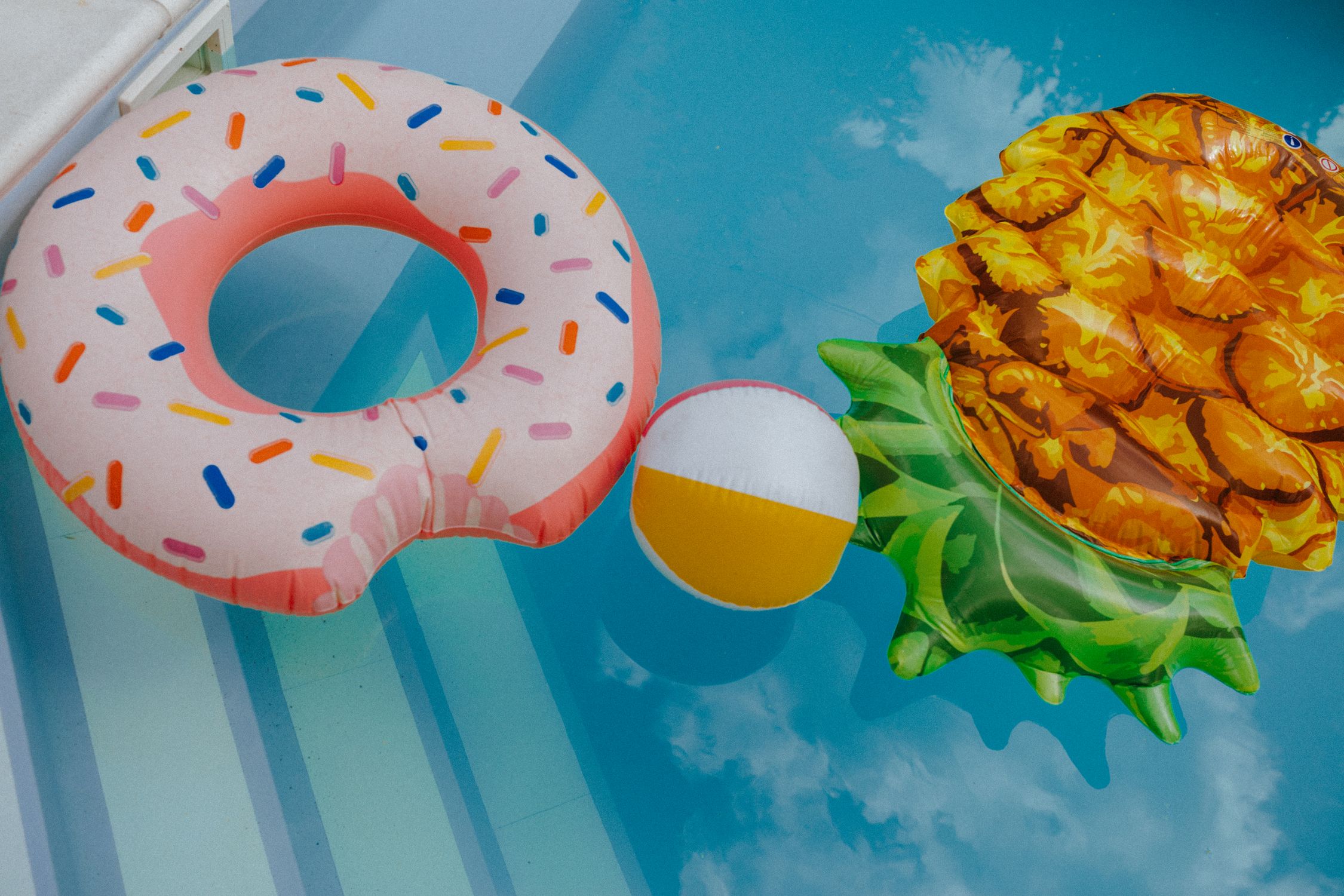
Cheap inflatable toys with no UV resistance. Thin PVC film without a UV stabiliser turns brittle within a single season in direct sun, cracks along the seams and can release its dye into the water. Do not buy five cheap items — buy one good one that will last five years.
“Miracle” chemical-free products. Mineral cartridges, copper ionisers and preparations promising water entirely without chemicals work as a supplement, not as a replacement for disinfection. Without an oxidising agent, organic residues will not break down. We examine the real alternatives to chlorine and their limits in our article on active oxygen and chlorine-free disinfection.
The undersized filtration that comes with a set. The most common source of frustration with above-ground pools: the pump in the box is sized for the volume on paper, not for the real load. The water is then never quite clear, whatever you do. Before you spend money on more chemicals, work out the required output using our article on how to choose a pool pump.
A floating dispenser near steel parts. A tablet float that comes to rest against a steel ladder, a stainless handrail or an aluminium coping strip creates an extremely high chlorine concentration at the point of contact. The result is usually rust and a permanent stain on the liner. Either use automatic dosing, or dose directly into the skimmer.
Cheap solar showers without a mixer. A shower with no mixer tap can deliver water above 60 °C at midday and ice-cold water in the evening. With children that is a safety risk. And the price difference between the version with a mixer and the one without is small.
Equipment for children and games
Family pools follow a different logic: what actually gets used are swimming aids, dive rings and a ball — things for active play, not large inflatable loungers. Choose armbands and swim belts according to the child’s weight and check for the EN 13138 marking.
The key point is that equipment should support learning, not passive floating on the surface. Dive rings and toys that sink to the bottom motivate a child to put their face in the water — the first and hardest step, as described in our article on how to teach a child to swim. How to adapt the whole pool to a family with small children is covered in our text on the pool for children.
Equipment for competitive swimming
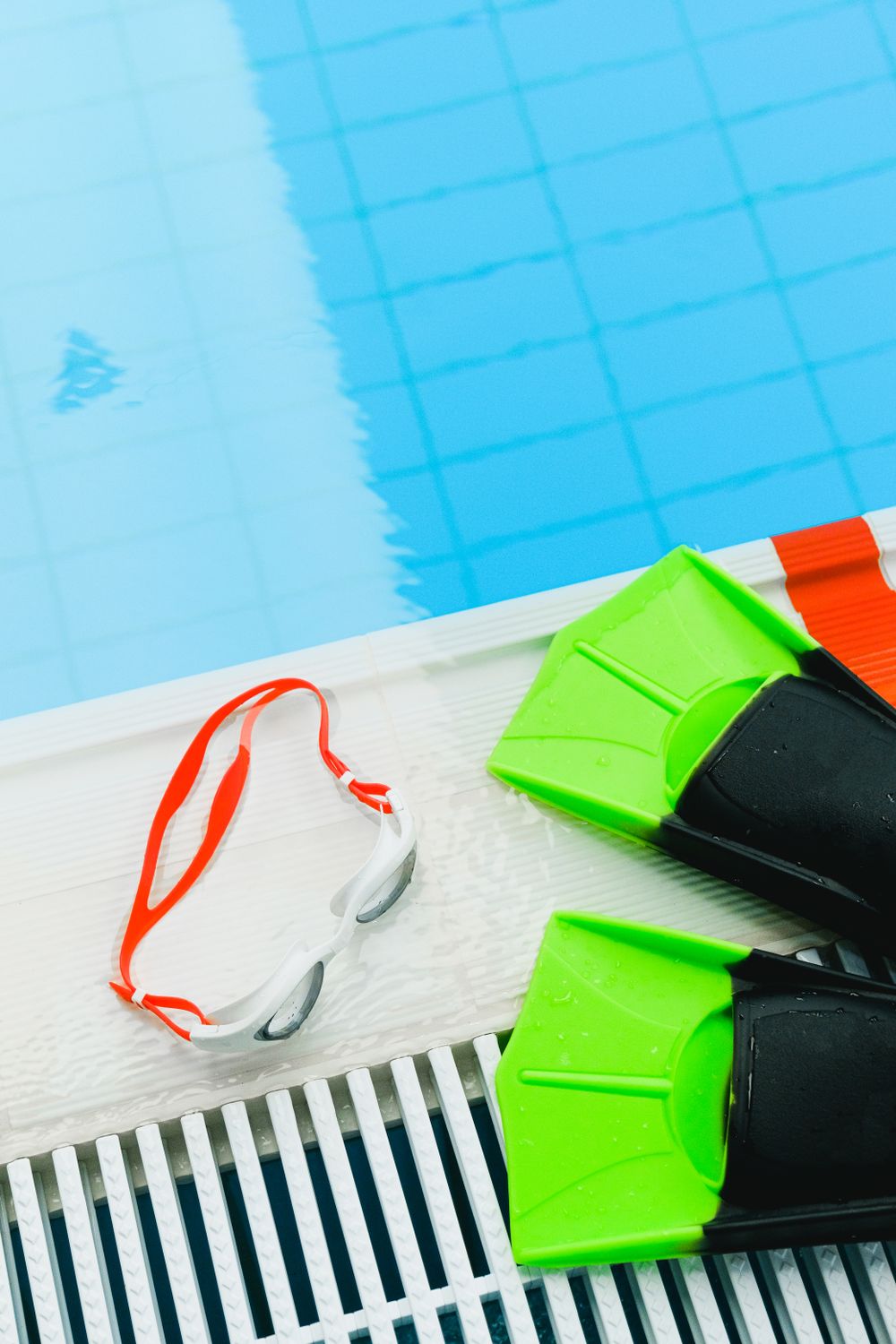
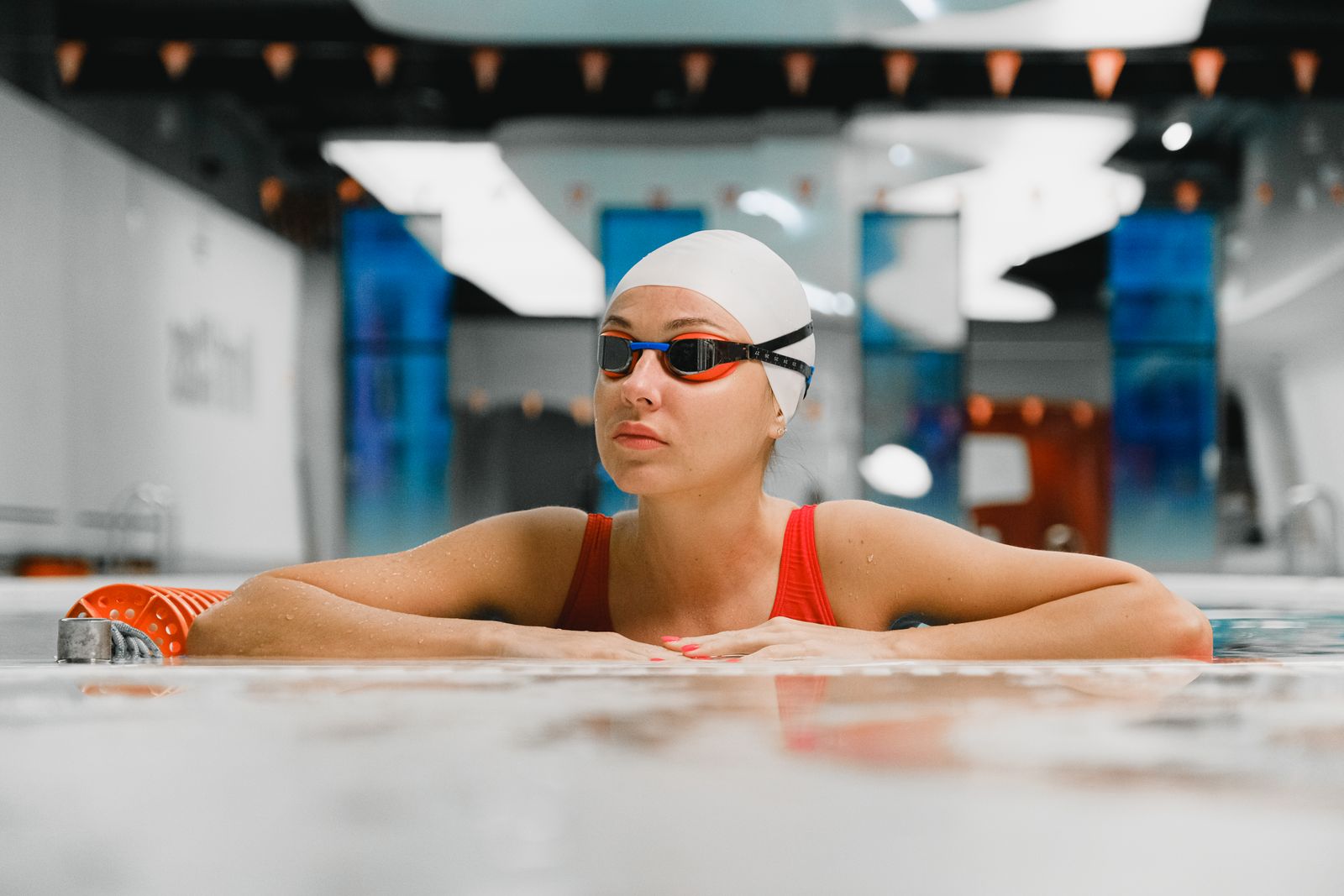
If you use your pool for swimming, three things will change the experience more than anything else. Good swimming goggles with an anti-fog coating (from 16 €) — cheap goggles fog up and press into your face. Resistance aids such as a kickboard, a pull buoy, hand paddles or water dumbbells will broaden your training even in a small pool; you will find sets of exercises in our article on water aerobics and exercising in the pool.
And finally a counter-current unit, which turns a pool of any length into an endless lane. It is the largest single investment of all the accessories, but in pools shorter than ten metres it fundamentally changes how they are used — the specifications and installation requirements are summarised in our text on the counter-current unit for pools.
First-year budget plan
The most common mistake new owners make is spending their entire accessory budget in the first week. We recommend splitting the purchases into three waves — the second comes after a month of operation, the third only before the second season.
| Wave | When | What to buy | Guide budget |
|---|---|---|---|
| 1. Essentials | before filling | tester, net + pole, brush, thermometer, starter chemicals, cover | 160–320 € |
| 2. Everyday comfort | after 4–6 weeks | vacuum according to real need, skimmer socks, second filter cartridge, steps or handrail | 120–800 € |
| 3. Upgrades | before the 2nd season | cover lifter, lighting, garden shower, smart sensor, sports aids | 200–1 200 € |
| Reserve | ongoing | spare parts, chemical top-ups, minor maintenance | 120–240 € a year |
The ranges are deliberately wide — what decides is the size of the pool, the type of filtration and whether you have an in-ground pool, an above-ground set or a hot tub. Stick to the order, though: never postpone the essentials, and never buy an upgrade before you know which problem it solves.
Frequently asked questions
Is it better to buy equipment as a set or individually?
A basic set of net + brush + pole is usually good value, because the components fit together. With more expensive items — vacuums, filtration, dosing — sets do not pay off; they typically contain one good piece and several weak ones that you will soon replace anyway.
How much do pool consumables cost per year?
For an ordinary family pool of 30–40 m³, budget 120–240 € a year for chemicals, test strips, replacement cartridges and small items. For a hot tub the amount is similar, but distributed differently — more chemicals, less mechanical equipment.
Do I need a robotic vacuum if I have a small above-ground pool?
Generally no. In pools up to 4 metres in diameter, a manual pole vacuum connected to the skimmer will handle the maintenance for a fraction of the price. A robot makes sense from roughly 25 m³ upwards, in in-ground pools with vertical walls, and wherever you would rather spend your time on something else.
What is the one accessory everyone should buy?
A surface cover. It reduces evaporation, heat losses and chemical consumption all at once, and its payback is counted in months, not years. On a hot tub it also protects the acrylic and the electronics.
Can equipment be bought gradually, or do some things have to be bought together?
Practically everything can be bought gradually, with two exceptions: the telescopic pole has to match the attachment system of the net, brush and vacuum (stick to one standard), and a dosing device is worth buying together with a tester, otherwise you are setting the dose by guesswork.
In conclusion
Good equipment is recognisable by the fact that you reach for it every week. Most disappointment comes from buying ahead — from acquiring a solution before you had met the problem. Start with the seven essentials, give yourself a month, and only then add to them.
You will find the full range of nets, poles, brushes, steps and accessories in the pool equipment category, and filter cartridges, vacuums and consumables in the pool maintenance section. More practical guides are waiting in the Guide.
