
A wrinkle on the pool floor looks dramatic, but it very rarely means the liner is ruined. Behind the one layman’s description “I have bumps in my liner” hide three completely different faults, each with a different cause and a different repair cost: water behind the liner, gas or moisture in the substrate, and the liner being mechanically pulled out of its track. Before you tackle anything, you need to know which of the three you are dealing with — and above all, do not drain the pool in the meantime.
This text is about diagnosing and repairing an existing liner. If you are dealing with a full shell refurbishment, the article on lining a pool with reinforced membrane is more relevant, and for choosing the material see how to choose a pool liner.
Three phenomena that get confused
You can tell them apart by where the fault shows and how it behaves when touched. The table below is the first filter — details on each case follow further down.
| Symptom | Where | Behaviour | Most common cause |
|---|---|---|---|
| Wrinkles and folds on the floor | floor area, floor-to-wall transition | soft, like a “water bed”, shifts underfoot | water behind the liner |
| Bumps and blisters | walls and floor, localised | firmer, stays put, does not move | moisture or gas in the substrate |
| Pulled out of the track or corner | top edge, corners, steps | liner slack, substrate visible | mechanical stress, negative pressure |
| Fine creases | corners, floor by the steps | firm, flat, not growing | usually not a fault |
1. Wrinkles and folds on the floor: water behind the liner
The most common case. The liner on the floor lifts into soft waves that you can “chase” from place to place with your foot. That is the unmistakable signature of water that has got between the liner and the substrate. The liner itself is usually perfectly fine — it is merely lifted.
There are essentially three sources of that water:
- A leaking pool. Water escapes from the shell into the structure — most often at penetrations, inlets, the skimmer, the light or through a damaged weld. You spot it by a falling water level.
- Groundwater. The water table rises after rain or in spring and presses on the shell from the outside. Meanwhile the level in the pool does not drop at all.
- Rainwater ingress. Badly graded paving, a leaking track edge or missing drainage around the pool — water runs down behind the liner from above.
Two further causes have nothing to do with water. In a thin replaceable liner (0.6–0.8 mm) the material loses elasticity over the years and slackens — after eight to twelve years permanent folds appear that nothing will undo. And then there is poor installation: a liner has to be fitted warm and kept under tension throughout, otherwise folds are there from the very first filling.
2. Bumps and blisters under the liner
A bump differs from a wrinkle in that it is localised and does not move. It tends to be firmer, clearly bounded, anywhere from the size of a palm to half a metre. Inside there is either condensed moisture or gas.
Typical causes:
- A damp substrate at installation. The concrete was lined before it had cured and dried sufficiently. Residual moisture then evaporates into the space behind the liner.
- Missing or damaged waterproofing. Moisture wicks up from the subsoil into the structure. The fix is systemic, not cosmetic — the background is covered in the article on waterproofing a concrete pool.
- Gas from the substrate. Decomposition of organic residues or a reaction in a poor-quality levelling layer. Rarer, but it happens.
- Chemical attack. Persistently low pH or direct contact between undissolved chlorine and the liner damages the surface and accelerates blistering.
In concrete shells without a liner and with a poorly prepared base the same problem shows up differently — the relationship between the subsoil and how the shell behaves is examined in the text on the pool base slab and foundation.
3. Liner pulled out of the track or a corner
The third scenario is mechanical. The liner comes free of the top coping track, jumps out of a corner or pulls away from a step. You can see the substrate and the liner hangs slack.
The usual causes:
- Negative pressure behind the liner. A falling groundwater table or rapid pumping of water out from under the shell sucks the liner in and rips it out of the track.
- Draining the pool abruptly. The most common mistake made by DIY owners. Without the counter-pressure of the water the liner shrinks immediately.
- Thermal stress. A liner in direct sun in an empty pool heats up and expands uncontrollably; once it cools it contracts and no longer fits.
- Poor fixing. A sparsely anchored track, missing sealant, undersized anchoring in corners and around steps.
When it is not a fault
Not every unevenness is a problem. On a thin replaceable liner fine creases in the corners and transitions after filling are normal — the bag is made to a production tolerance and the water only partly stretches it out. The material also smooths itself out partially when warm: after a few days of operation at 26–28 °C light folds usually settle by themselves.
Treat as a fault any unevenness that moves, grows or has appeared suddenly. A fold that looks exactly the same in last year’s photo as it does today is cosmetic. A wrinkle that was not there and is a metre long a week later is a diagnosis.
How to find out what you are dealing with
Checking the water level and consumption
The simplest test is the bucket test. Stand a bucket of water on a step, mark the level inside and outside, and compare after 24 hours. If the pool level has dropped more than the bucket, the pool is leaking. The procedure is described in detail in the article on water loss versus evaporation. Treat roughly 3–5 mm a day as normal summer evaporation; for context on the overall balance see the text on pool water usage.
Checking drainage and groundwater
If the level is not dropping but the wrinkles are still growing — typically after heavy rain or in spring — it is almost certainly water from outside. Check the drainage chamber beside the pool: is there water in it? Is the pump working? The background and the solutions are covered in the article on groundwater and pool drainage.
Checking penetrations and inlets
Penetrations are the most common leak point. Go over the inlets, the skimmer, the main drain, the counter-current unit and the underwater light — look for liner lifting around the flange, a rippled edge or discoloured substrate. Dyed water helps: a few drops of test dye at a penetration with the filtration switched off will show where the water is going.
Repair options by cause
| Cause | Intervention | Indicative price 2026 |
|---|---|---|
| Water behind the liner with no leak | extracting the water from behind the liner and venting | from approx. 240 € |
| Leaking weld or penetration | local repair, welded patch, resealing the flange | 120–480 € |
| Slack liner | re-tensioning and heating, reseating in the track | from approx. 320 € |
| Pulled out of the track | resealing and re-anchoring the track | 80–320 € |
| Groundwater | adding or renewing drainage and pumping | 600–2,400 € |
| Liner degraded over the years | complete replacement | from approx. 32 €/m² |
The prices are indicative ranges based on common practice among installation firms in 2026; a specific quotation depends on the size of the pool, access and the condition of the substrate. Take them as an order of magnitude, not a binding calculation.
The rule is simple: as long as the liner holds and does not leak, it is repaired locally. Complete replacement only makes sense once the material is past its service life, has gone brittle, lost its colour or tears at every patch.
Why you should never drain a lined pool yourself
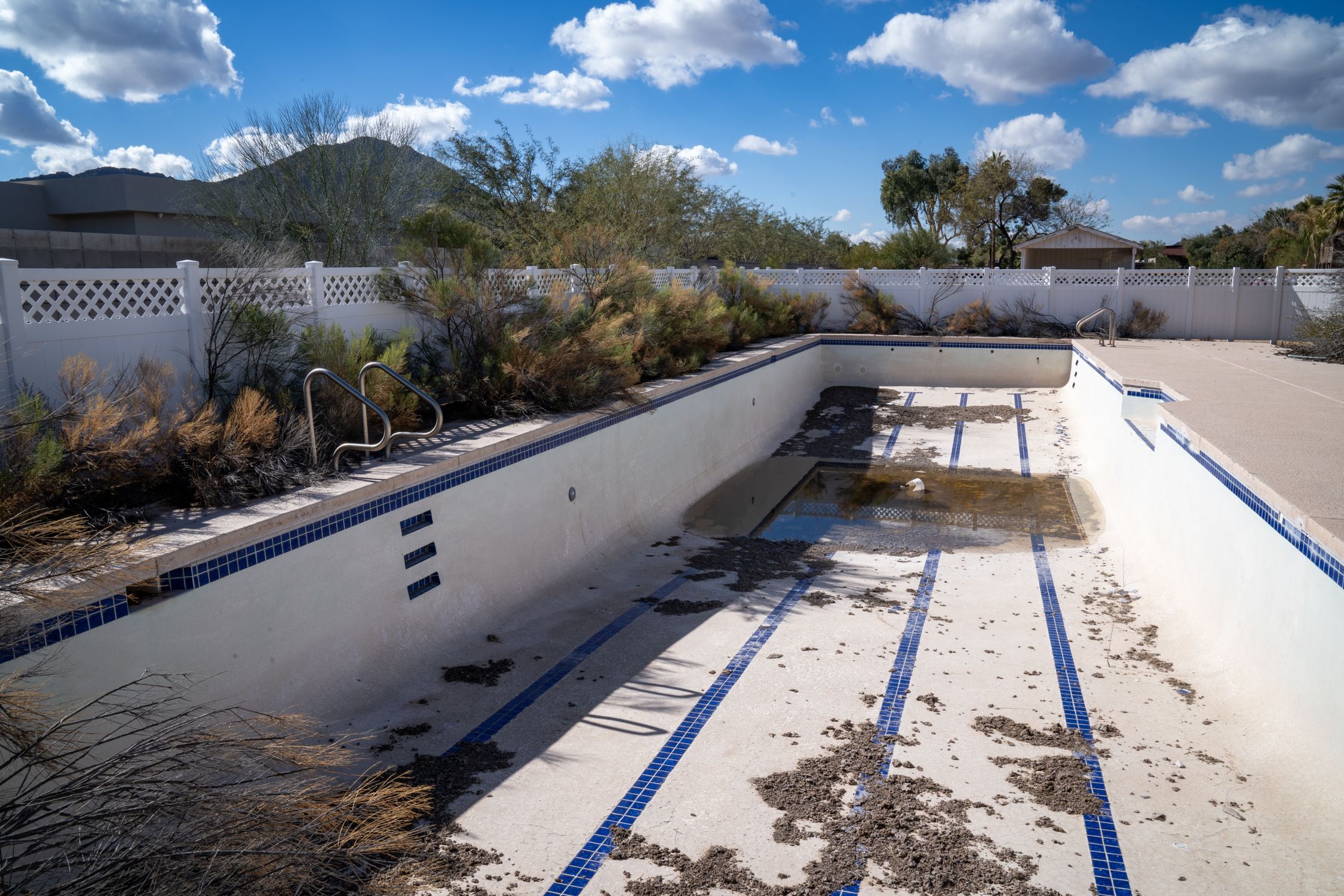
This is the most important sentence in the whole article. Draining a lined pool is an operation you can get wrong once, irreversibly. Never do it on your own without consulting a specialist first.
The liner shrinks. Without the water column it loses the counter-pressure, heats up in the sun, contracts, and on refilling it no longer fits its original shape. A repair costing a few hundred euros turns into a replacement costing thousands.
The structure can float. When the groundwater table is high, what holds the shell in the ground is the weight of the water inside it. As soon as you drain that away, buoyancy can lift the empty shell, crack it or shift it — on fibreglass shells by tens of centimetres.
When you really do need to drain, it goes hand in hand with checking the drainage, pumping groundwater away the entire time, shading the liner and keeping the empty period as short as possible. That is a job for a professional firm. Where you may legally put the drained water is covered in the article on where to put water from the pool.
What a warranty claim covers
Distinguish between a material defect, an installation defect and an operating influence. A split weld, delamination of the liner or the liner pulling out of an inadequately anchored track are generally defects in the work. Conversely, folds caused by groundwater that the installer had allowed for and you failed to maintain the drainage, or liner damage from persistently low pH, are not covered by a claim.
A practical approach: take photographs as you go (the date is crucial), keep the handover protocol and records of water values, and report the fault immediately, not at the end of the season. How to word a claim and what you can realistically enforce is examined in the text on warranty claims for pools and hot tubs.
Prevention: five things that make the difference
- A good substrate and geotextile underlay. A level, dry, cured substrate and a geotextile underlay beneath the liner are cheaper than any later repair.
- Working drainage. Check the chamber and the pump once a year — ideally in spring, when opening the pool.
- Do not drain without reason. A liner is happiest under water. Even for the winter a lined pool is left full — the procedure is covered in the article on winterising a pool.
- Protect against negative pressure. Never pump groundwater away at full rate under an empty pool, and in winter operation make sure the level does not drop below the track.
- Keep an eye on the chemistry. Hold pH in the 7.0–7.4 band. Permanently below 7.0 it dries the liner out, bleaches it and accelerates embrittlement; never tip granular chlorine straight onto the floor. The routine is described in the article on how to test your water.
FAQ
Can I just leave a wrinkle on the floor alone?
If it is not growing and the level is not dropping, it is not an emergency — but nor is it cosmetic damage you can ignore forever. Water behind the liner soaks the substrate and the liner wears faster where it folds. Have the cause identified and plan the work for the off-season.
How do I tell a bump from a wrinkle?
Step on it. A wrinkle flows elsewhere and comes back; a bump stays put and is firmer. A wrinkle means water, a bump means moisture or gas in the substrate.
Can water be extracted from behind the liner without draining the pool?
Yes, and it is the standard procedure. The firm makes a controlled puncture or uses an existing penetration, extracts the water and re-welds the spot. The pool stays full throughout, which protects both the liner and the structure.
Will the folds smooth out by themselves if I heat the pool?
Fine creases on a new liner will — warm water softens the material and the water stretches it out. Folds caused by water behind the liner or by material fatigue will not be solved by heat; it only temporarily improves their appearance.
How long does a liner last before folds appear?
On a thin replaceable liner reckon on 8–12 years, on a welded 1.5 mm reinforced membrane 15–20 years with pH kept in range and sensible maintenance. Low pH and aggressive dosing can cut that service life by as much as a third.
In conclusion
Folds in a liner are usually a symptom, not a diagnosis. Before you call a firm, establish two numbers: whether the level is dropping and whether there is water in the drainage chamber. With those two figures the repair is quick and cheap; without them it is guesswork. And until you know what is going on, leave the pool full.
Tracks, sealing kits, penetrations, inlet flanges and the other parts replaced during a liner repair can be found in the pool construction parts category. Further texts on pool maintenance and equipment are in the Guide.
