
If the pH in your pool climbs again a few days after a dose of acid, you are not doing anything wrong — it is physics. The water is shedding dissolved carbon dioxide, and with every bubble that escapes the pH goes up. There is only one way to stop it for good: bring total alkalinity into line and reduce the amount of agitation at the surface. Simply topping up with more acid only treats the symptom.
What pH should a pool actually have?
For a private pool the optimum is usually quoted as pH 7.0–7.4, with a tolerance up to 7.6. As an example of one country’s rules, the Czech decree No. 238/2011 Coll., which applies to public pools, permits a range of 6.5–7.6 — other countries have their own standards, but the figure is still a useful guide to when the situation is tolerable and when it is not.
Why such a narrow window? Chlorine efficiency is extremely sensitive to pH. Chlorine exists in water in two forms: as hypochlorous acid (HClO, the one that actually disinfects) and as the hypochlorite ion (ClO⁻, weaker by an order of magnitude). The ratio between them is set by pH:
- pH 7.0 — roughly 75 % of the chlorine is in the effective HClO form
- pH 7.5 — approximately 50 %
- pH 8.0 — only around 22–24 %
In other words: at pH 8.0 the same dose of chlorine gives you about a third of the effect it would have at pH 7.0. The water “goes green” not because there is too little chlorine, but because the chlorine has been taken out of service. How to measure both correctly is covered in our article on how to test pool and hot tub water.
The main mechanism: CO₂ off-gassing
Pool water contains dissolved carbon dioxide, which forms weak carbonic acid in it. That acid holds the pH down. But the CO₂ concentration in the water is usually far higher than equilibrium with the surrounding air would require — and under Henry’s law the gas tries to even that out. So CO₂ escapes from the water, carbonic acid is depleted and the pH rises on its own.
The process does not run on forever. The water settles at what is called the pH ceiling, which for ordinary pool water sits around 8.2–8.3. That is, however, a level at which chlorine has effectively stopped working and calcium starts to precipitate — so waiting “until it settles by itself” is not a solution.
The rate of off-gassing is driven above all by how much surface is in contact with the air and how agitated it is. Every feature that makes bubbles or breaks up the water acts as an accelerator:
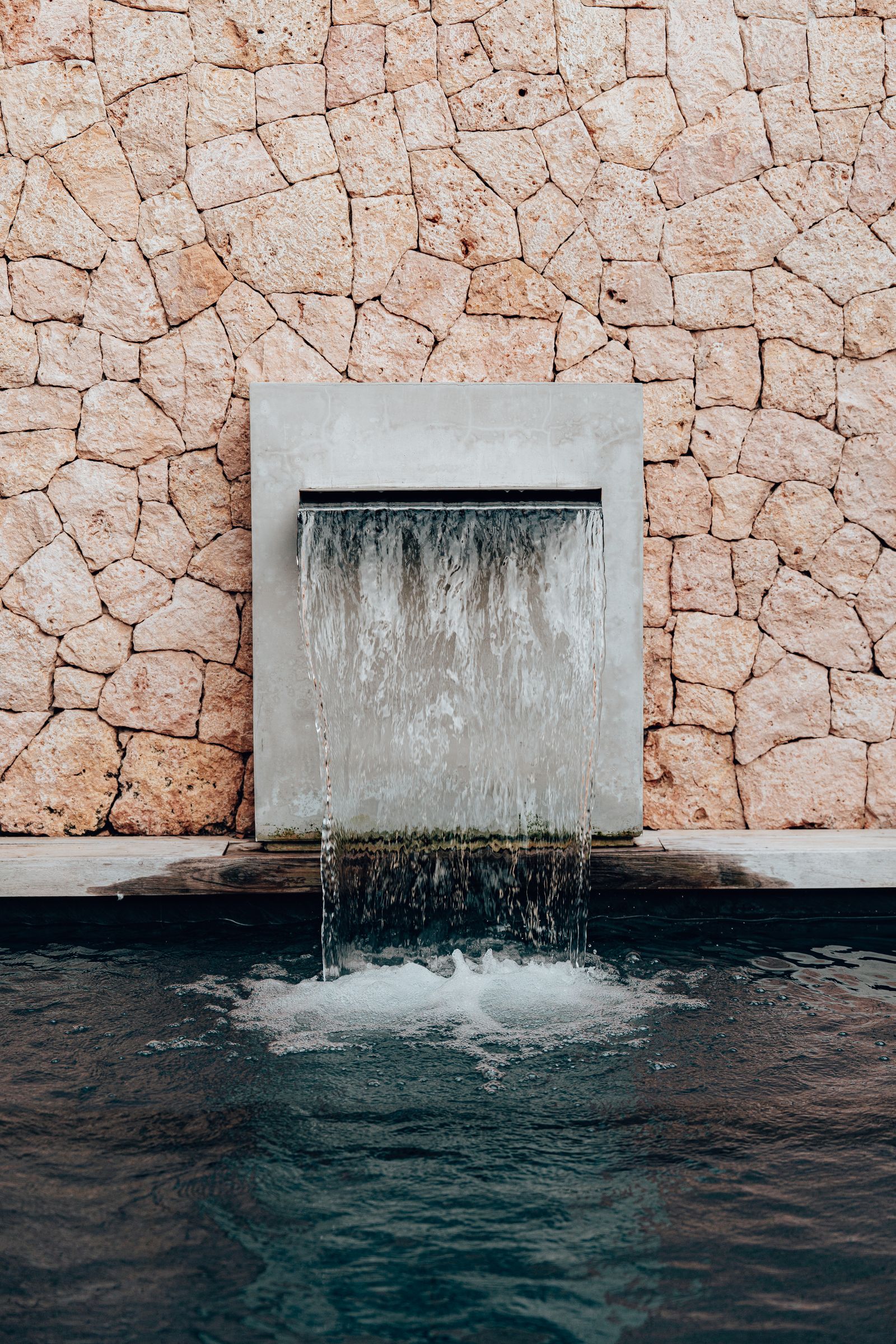
- waterfall, spout, cascade — the strongest source, water falls through the air and shatters on the surface
- counter-current swim jet — massive turbulence; in some pools it lifts the pH by two tenths over a weekend
- fountain jets and water features — low flow, but a large contact area
- air massage (aeration) — blows air straight into the water, so the most effective gas exchange there is
- return jets aimed upwards — if they ripple the surface, they behave like mild aeration
- bathers, rain, wind — far from negligible, but hard to control
High total alkalinity: the most common hidden culprit
This is where it is decided. Total alkalinity (TA) is a buffer — a reserve of bicarbonates that keeps pH from swinging sharply. The recommended range is 80–120 mg/l.
But those bicarbonates are also a store of CO₂. The higher the alkalinity, the more CO₂ the water can release — and the more stubbornly the pH is pushed upwards. At an alkalinity of 180 or 220 mg/l you add acid, the pH drops, three days later it is back up and you start again. It is an endless fight, because you are knocking down the consequence, not the cause.
A practical rule: if the pH rises faster than roughly once a fortnight, measure the alkalinity before you reach for another pack of pH decreaser. In pools with a persistently rising pH — typically those with a salt chlorine generator or a water feature — it pays to keep alkalinity nearer the lower limit, 60–90 mg/l. The buffer is then weaker, but the pH is finally calm.
Type of disinfection: what raises your pH all by itself
A salt chlorine generator raises pH systematically, in practically every pool. For a long time this was blamed on the sodium hydroxide formed at the cathode in the cell — but that is largely neutralised by the acidic chlorine formed at the anode. The real reason is mechanical: hydrogen is released at the cathode, does not dissolve in water and bubbles up to the surface. That creates permanent fine aeration — and that drives off CO₂. So the salt cell does not raise pH chemically, but by aerating the water continuously. We look at the wider picture in our article on salt water vs. chlorine and in the piece on salt cell maintenance.
With conventional chemicals it depends on the product:
- Sodium hypochlorite (liquid chlorine) has a pH of around 13 — dosing it raises pH.
- Calcium hypochlorite has a pH of around 11.8 — it also raises pH, and adds calcium to the water on top of that.
- Trichlor (tablets) is strongly acidic by contrast, pH around 2.8–3.0 — it lowers both pH and alkalinity. If your pH is rising even with trichlor, the cause lies elsewhere.
- Dichlor is roughly neutral (pH around 6.7).
New concrete and fresh grout
In a newly built concrete pool, after new rendering or after regrouting tiles, calcium hydroxide with a pH of around 12 leaches out of the surface. The water dissolves it and drives the pH upwards — often by several tenths a week, no matter what you do.
This is not a fault, it is the material curing. Roughly 60 % of the process happens during the first 28 days, the rest drags on for another 6 to 10 months. In the first season, then, expect higher acid consumption, measure more often and watch hardness as well — calcium in the water rises visibly. After a year it sorts itself out.
Top-up water with high alkalinity
Evaporation in summer is not trivial, and top-up water brings its own chemistry. Hard, calcium-rich water from the mains or a well commonly has an alkalinity of over 200 mg/l — so with every top-up you are also topping up the buffer that pushes pH upwards. An analysis of the top-up water is therefore the first thing anyone who repeatedly battles a rising pH should have in hand. More in the articles on water hardness and scale build-up and well water in your pool.
The correct fix — in this order
The order of the steps matters more than the products themselves. Most people start at point 3 and then wonder why it does not hold.
- Measure total alkalinity, not just pH. Without a figure for alkalinity, any intervention in pH is shooting blind. Measure hardness and the state of the top-up water at the same time.
- Bring the alkalinity down with acid — using the right technique. The target is 60–90 mg/l in pools with a persistently rising pH. Work out the dose according to the product instructions and dilute it beforehand in a bucket of pool water, then pour it slowly into the moving water at a return jet or into the deepest point, with the filtration running. Let it circulate for at least 30 minutes, then measure again. Lowering alkalinity usually takes two or three interventions spaced days apart, not one big dose.
- Only then deal with pH. Once alkalinity is down, pH settles on its own and any correction finally holds. If the pH drops too low after the alkalinity treatment (below 7.0), let it climb back naturally — by exactly that CO₂ off-gassing. Alkalinity stays down in the meantime. That is the whole trick: it is how you decouple pH from alkalinity.
- Reduce aeration. While you are bringing things into line, switch off the waterfall, the swim jet, the fountain and the air massage, and angle the return jets slightly downwards so they do not break up the surface. The difference tends to be surprisingly large.
- With salt water, adjust the output of the electrolyser. Reduce production to the minimum that still holds free chlorine in range, and shorten the run time. Fewer hours of electrolysis means fewer hydrogen bubbles, and so less off-gassing. Check pH every other day for the first two weeks.
Cause → how to spot it → what to do
| Cause | How to spot it | What to do |
|---|---|---|
| Natural CO₂ off-gassing | pH rises slowly, acid is needed once every 1–2 weeks, alkalinity in range | Nothing out of the ordinary — just regular correction, this is normal operation |
| High total alkalinity | TA above 150 mg/l, pH back up within 2–4 days after every dose | Gradually bring alkalinity down to 60–90 mg/l, only then fine-tune pH |
| Water features and aeration | pH jumps precisely after days when the waterfall, swim jet or air massage was running | Run the features only while bathing, aim the jets below the surface |
| Salt chlorine generator | Steady daily rise in pH even when nothing is happening in the pool | Reduce cell output and run time, keep alkalinity low, measure more often |
| Sodium or calcium hypochlorite | pH rises every time shortly after the disinfectant is dosed | Consider a different form of chlorine, dose smaller amounts more often |
| New concrete, fresh grouting | The pool is in its first season, water hardness is rising too, the surface tends to be dusty | Sit it out and correct more often — after 6–12 months it fades by itself |
| Top-up water | pH and alkalinity rise mainly after topping up during a hot week | Have an analysis done, tackle evaporation by covering the surface, top up in smaller amounts |
What happens if high pH is left unaddressed
Persistently high pH is not a cosmetic problem. It adds up into several costly consequences at once:
- Chlorine that does not work. Above pH 7.8 the disinfection simply cannot keep up, and cloudiness and algae follow.
- Scale. Calcium precipitates on the walls, steps and tiling as a greyish-white coating that only comes off with acid or mechanically.
- Persistent cloudiness. The water looks “milky” even when chlorine is in range — those are microscopic crystals of calcium carbonate.
- Eye and skin irritation. It has become common to blame chlorine. In reality it is usually pH that has drifted — tears have a pH of around 7.4, and water outside that band simply stings.
- Fouled heating element and heat exchanger. A calcium coating on the exchanger reduces heat transfer, lengthens heating times and increases energy consumption. With heat pumps, a fouled exchanger is a frequent cause of insufficient heating.
- Ruined salt cell electrodes. The cell scales up, chlorine production falls and the life of an expensive cell is cut short.
Safety when working with acid
Acid for lowering pH — whether granular sodium bisulphate or liquid sulphuric or hydrochloric acid — is among the most hazardous things you keep around the pool. The basic rules:
- Always follow the instructions for the specific product and its safety data sheet. Concentrations differ markedly between products, and the information on the packaging takes precedence over any general recommendation.
- Never pour concentrated acid into still water in one spot. You will damage the liner, the grout and the pool render. Always dilute it in a bucket first and then pour it slowly into moving water.
- Acid into water, never water into acid. The reverse order can cause violent splashing.
- Protective equipment. Resistant gloves, goggles or a face shield, long sleeves. Work downwind.
- Never mix acid with chlorine. Not in the same bucket, not in the same dosing vessel, and not one shortly after the other into the same spot in the pool. Chlorine gas is produced, which is life-threatening if inhaled. Between doses, let the water run through the filtration for several hours.
- Storage. Separately from hypochlorites and chlorine tablets, in closed original containers, out of reach of children and in a dry place.
When to call a service technician or have the water analysed
Home test kits handle everyday operation, but they have their limits. A professional analysis or a service visit makes sense when:
- you have brought the alkalinity into the recommended band and the pH still rises by two tenths a day;
- you test with both a drop test and strips and the values contradict each other (a photometric analysis gives certainty);
- you suspect high levels of dissolved solids, metals or phosphates — a home kit will not measure those;
- the pool is fed from a well and the behaviour of the water changes from season to season;
- calcium precipitates repeatedly even at a correct pH — that points to a combination of hardness, alkalinity and temperature;
- you have automatic pH control and the probe reports different values from a manual test (the probe needs calibrating or replacing).
Frequently asked questions
How often is it normal to lower the pH?
In a well set-up pool with alkalinity in the 80–120 mg/l band and no permanently running water features, a correction roughly once every one to two weeks is enough. If you need acid more often than every three days, something else is not right — most often alkalinity or aeration.
Can I lower alkalinity without lowering pH at the same time?
Not directly, acid lowers both at once. The trick is that you let the pH climb back on its own after the treatment (through CO₂ off-gassing), while the alkalinity stays down. That is why, after lowering alkalinity, it is actually recommended to switch the water features on temporarily — the pH comes back faster and the alkalinity does not follow it up.
Why does pH never rise above 8.2?
That is the so-called pH ceiling — the point where the CO₂ content of the water is in equilibrium with the surrounding air and off-gassing stops. The exact figure depends on alkalinity and temperature, but for ordinary pool water it sits around 8.2–8.3. It is not, however, a safe value: in that band chlorine barely disinfects at all.
Does it help to use “pH minus” tablets in a dosing unit?
Automatic pH dosing is convenient and helps maintain stability, but it does not replace correctly set alkalinity. If the alkalinity is too high, the doser will simply consume more chemicals for the same result. Alkalinity first, automation second.
Do rain and thunderstorms raise pH too?
Rain itself is rather acidic in reaction and lowers pH slightly, but it heavily dilutes alkalinity and brings in contaminants. Heavy rain also works as aeration — the surface is agitated and CO₂ escapes. After a storm, therefore, measure the complete set of values, not just chlorine. In more detail in the article on rain, storms and pool chemistry.
Summary
Rising pH is a natural state of pool water, not a defect. The difference between a pool that asks for acid once a fortnight and one that swallows it every three days comes down above all to total alkalinity and how much the surface is agitated. Measure the alkalinity, bring it into line, reduce aeration — and only then fine-tune pH. You will save chemicals, energy and nerves, as the article on how to save on pool chemicals also shows.
Reliable test kits, products for adjusting pH and alkalinity and automatic dosing systems can be found in the water treatment category. More practical guides to looking after your pool and hot tub are waiting in the Guide.
