
According to our model calculation, a single session in an ordinary home sauna uses roughly 6–13 kWh, which at €0.25/kWh comes to about €1.60–3.30. The difference between a small two-person cabin and a large family sauna is therefore roughly twofold — and most of the consumption is swallowed by the first hour, before the cabin is up to temperature. The figures that follow are a model estimate based on heater output and running time, not a measurement taken on a specific sauna; we state every assumption openly so that you can recalculate them for your own situation.
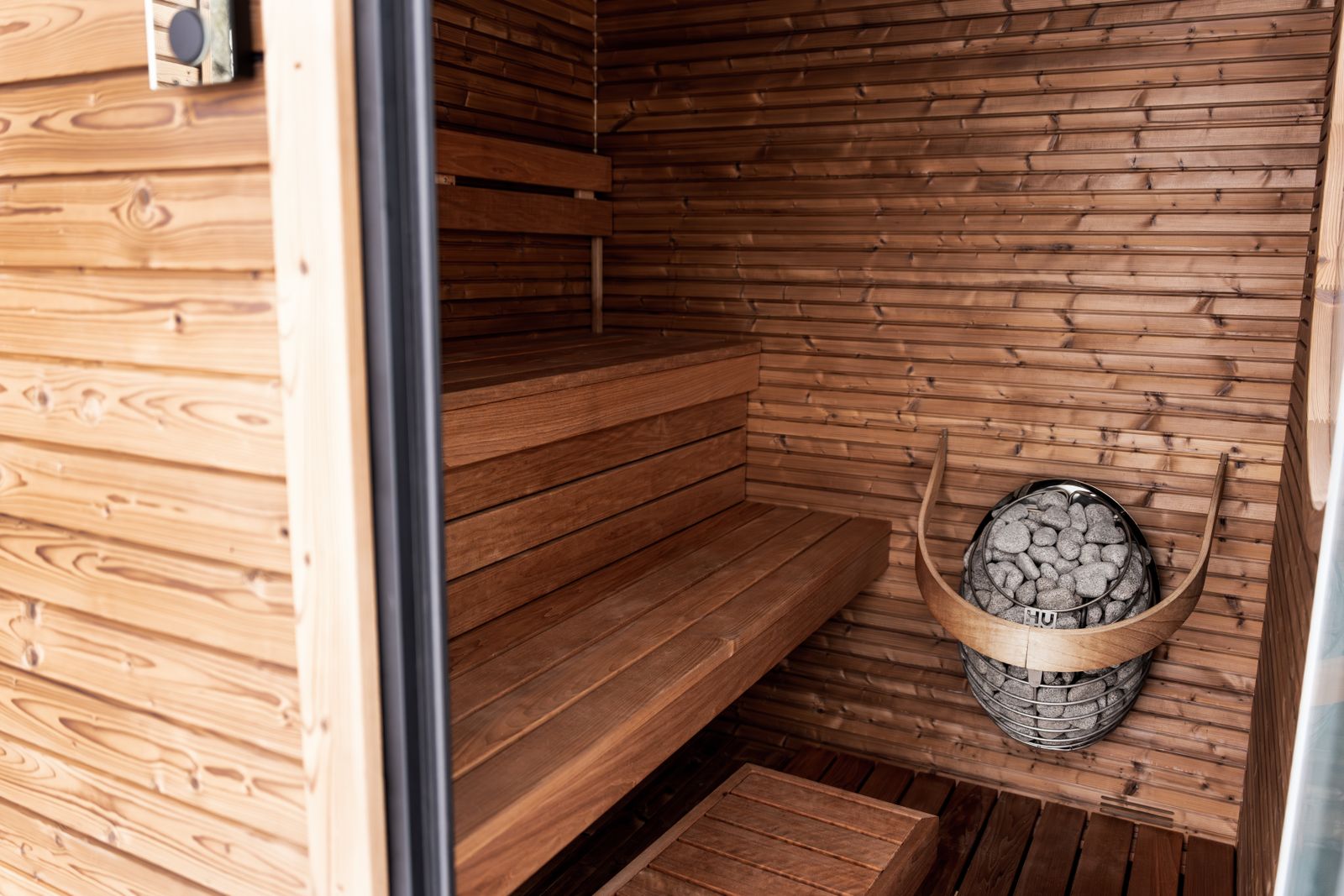
What sauna consumption is actually made up of
A sauna does not have a single “consumption per hour”. It has three phases that behave completely differently, and if you fail to separate them you end up with a number that is either frighteningly high or unrealistically low.
1. Heating the cabin up — the most expensive part
While the cabin is warming up, the heater runs practically continuously at full output. The energy goes into three places at once: heating the air, heating the sauna stones (which provide the thermal inertia of the whole sauna) and warming the timber cladding and the structure of the cabin.
This phase typically lasts 40–60 minutes and accounts for roughly half to sixty per cent of the total consumption of one session. That is precisely why the strongest lever for saving is also the simplest one: use the sauna with more people at once and do not start the heating-up phase twice a day.
2. Holding the temperature during the session — the heater only switches on part of the time
This is where the most common mistake arises. People take a 6 kW heater, multiply it by two hours and are horrified by 12 kWh. But once the set temperature has been reached, the thermostat switches the heater off and on — in a well-insulated cabin the real duty cycle is of the order of a third of the time, and considerably more in a glazed sauna on an outdoor terrace in winter.
Consumption in this phase therefore corresponds to something more like a steady 2 kW draw than 6 kW. It is increased by every opening of the door, every ladle of water on the stones (evaporation cools the water) and every extra degree on the thermostat.
3. Run-down and drying out
After the session the cabin has to be dried out, otherwise the timber takes up moisture and starts to smell. Some owners let the heater run for another 10–15 minutes with the ventilation open; elsewhere an open vent and a fan run-down is enough. This item is small compared with the rest — 0.5–0.8 kWh in our model — but it belongs in the total, as do the lighting and the control unit.
Model calculation: how many kWh does one sauna session use
So that the figure can be recalculated for your own sauna, we state all the assumptions explicitly. This is not measured data, but a calculation from heater output and estimated running time. The actual consumption of your sauna may differ from the model by tens of per cent in either direction.
Model assumptions:
- Heating up runs at the heater’s full output, for 45–60 minutes depending on the size of the cabin.
- During the session the heater is switched on 35 % of the time (a well-insulated cabin inside the house, target temperature 80 °C).
- Length of the session itself: 90 minutes (three rounds with breaks).
- Run-down and drying out: 0.5–0.8 kWh depending on size.
- Electricity price: €0.25/kWh including distribution and taxes (an indicative ordinary household rate; check your own on your bill).
| Cabin (volume) | Heater output | Heating up | Holding 90 min | Run-down | Total | Cost at €0.25/kWh |
|---|---|---|---|---|---|---|
| Small, 2 people (approx. 6 m³) | 4.5 kW | 3.4 kWh | 2.4 kWh | 0.5 kWh | 6.3 kWh | approx. €1.60 |
| Medium, 3–4 people (approx. 9 m³) | 6 kW | 5.0 kWh | 3.2 kWh | 0.6 kWh | 8.8 kWh | approx. €2.20 |
| Large, 4–6 people (approx. 12 m³) | 8 kW | 8.0 kWh | 4.2 kWh | 0.8 kWh | 13.0 kWh | approx. €3.30 |
Once the figures are worked out per person, a home sauna comes out surprisingly friendly: a large cabin with four people in it means roughly €0.80 a head for the whole evening.
Annual cost by how often you use the sauna
The annual figure is what really interests you when deciding whether to buy. It follows from the values in the table above and from the same price of €0.25/kWh — again as a model estimate.
| Cabin | Once a week (52 sessions) | Three times a week (156 sessions) |
|---|---|---|
| Small 4.5 kW | approx. 330 kWh — €82 | approx. 985 kWh — €246 |
| Medium 6 kW | approx. 460 kWh — €115 | approx. 1,370 kWh — €343 |
| Large 8 kW | approx. 675 kWh — €169 | approx. 2,030 kWh — €507 |
For most households that use the sauna once or twice a week in a medium cabin, then, running a sauna works out at something like €115–230 a year. That is a sum comparable to an ordinary domestic appliance, not to heating a house — and much lower than most people estimate before buying.
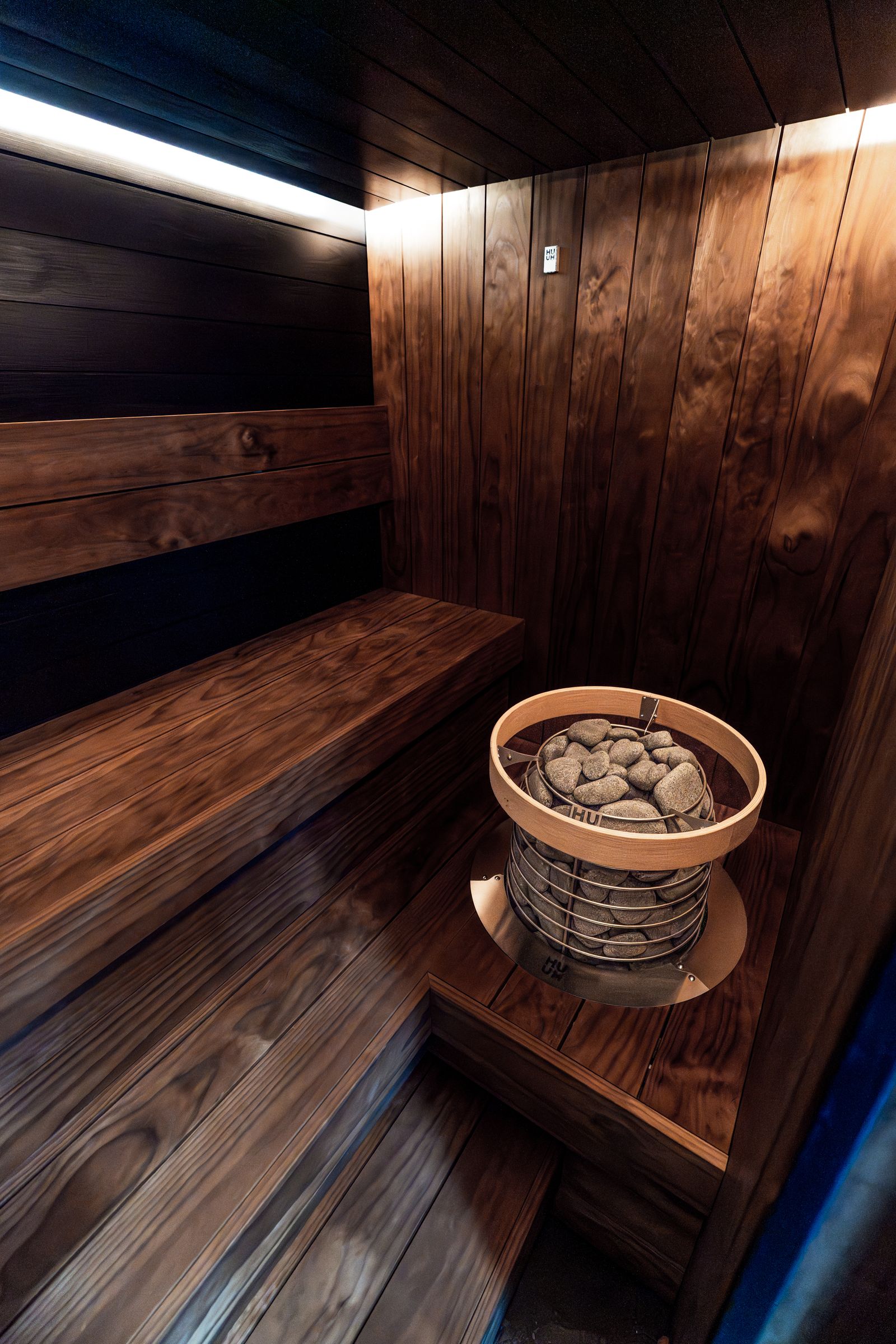
What influences consumption most
Insulation of the cabin and where it stands
The biggest difference between “model” and actual consumption comes down to how much heat the cabin loses to its surroundings. A sauna inside a heated house has 22 °C around it; an outdoor sauna in the garden in January has −5 °C. The temperature difference is decisive: for an outdoor sauna in winter, reckon on a duty cycle closer to 50–60 % than 35 %, and on longer heating-up times. Good wall insulation, a vapour barrier and a well-sealing door will squeeze that difference down substantially.
Glazing
A large glass wall is beautiful, and in the heat balance it is a weak point. Insulating double glazing can take the losses; single glazing cannot. When a sauna stands outdoors and has a glazed front wall, that shows up in consumption more than any clever controller.
Correctly set ventilation
Ventilation cuts both ways. A sauna needs it — without air exchange the session is unhealthy and the timber suffers. But an overdone extract means you are heating the garden. The difference between a badly and a well-adjusted air intake and extract shows up in operation as anything from a few per cent to tens of per cent of consumption. How to set it up is covered in our article on sauna ventilation and air intake and exhaust.
Heating up for nothing and needlessly high temperatures
Switching the sauna on “so that it is ready” and then changing your mind is the most expensive mistake of all — you pay for the whole of the most expensive phase and never use the sauna. Similarly, the difference between 80 °C and 100 °C means longer heating up and more frequent switching during the session. For most people 80 °C is more than enough, as we describe in our article on how to sauna properly.
Quality and quantity of the stones
The stones are the sauna’s heat store. Old, crumbling or badly stacked stones obstruct the airflow around the heating elements, the heater overheats, the thermostat switches erratically and the sauna holds its temperature less well. Replacing the stones is cheap maintenance with a real effect on consumption — the details are in our article on choosing, stacking and replacing sauna stones.
Heater output against cabin volume
An undersized heater does not save anything — it simply heats for longer and rarely reaches the target temperature, so it runs almost continuously. An oversized heater, on the other hand, switches on in short bursts and may dry the cabin out unevenly. Correctly designed output is the foundation of the whole saving; you will find how to calculate it in our article on sauna heater output in kW and how to calculate it.
How to cut the costs in practice
- Use the sauna with more people at once. Heating up is the expensive part and you pay the same for one person as for five. A family session divides the cost per person immediately.
- Do not heat to 100 °C when 80 °C will do. A lower target temperature shortens the heating-up phase and cuts the duty cycle during the session.
- Make use of a cheaper tariff or spot-price hours. A sauna is typically an evening affair, but heating up can be timed. If you are on a spot tariff, the principle and the risks are described in our article on hot tubs and pools on spot-priced electricity.
- Solar PV. An afternoon session in summer can run on surplus generation. Photovoltaics will cover summer rather than winter operation — the wider context is in our article on photovoltaics for a pool and hot tub.
- Vents and seals. Ventilation vent closed while heating up, open during the session and wide open while drying out. Free, and it works.
- A timer and smart control. Pre-heating scheduled for an exact time means the sauna does not sit hot and empty for an hour. Modern control units manage this from an app.
- Do not keep the sauna hot between sessions. This question comes up constantly — you will find the answer in the FAQ below.
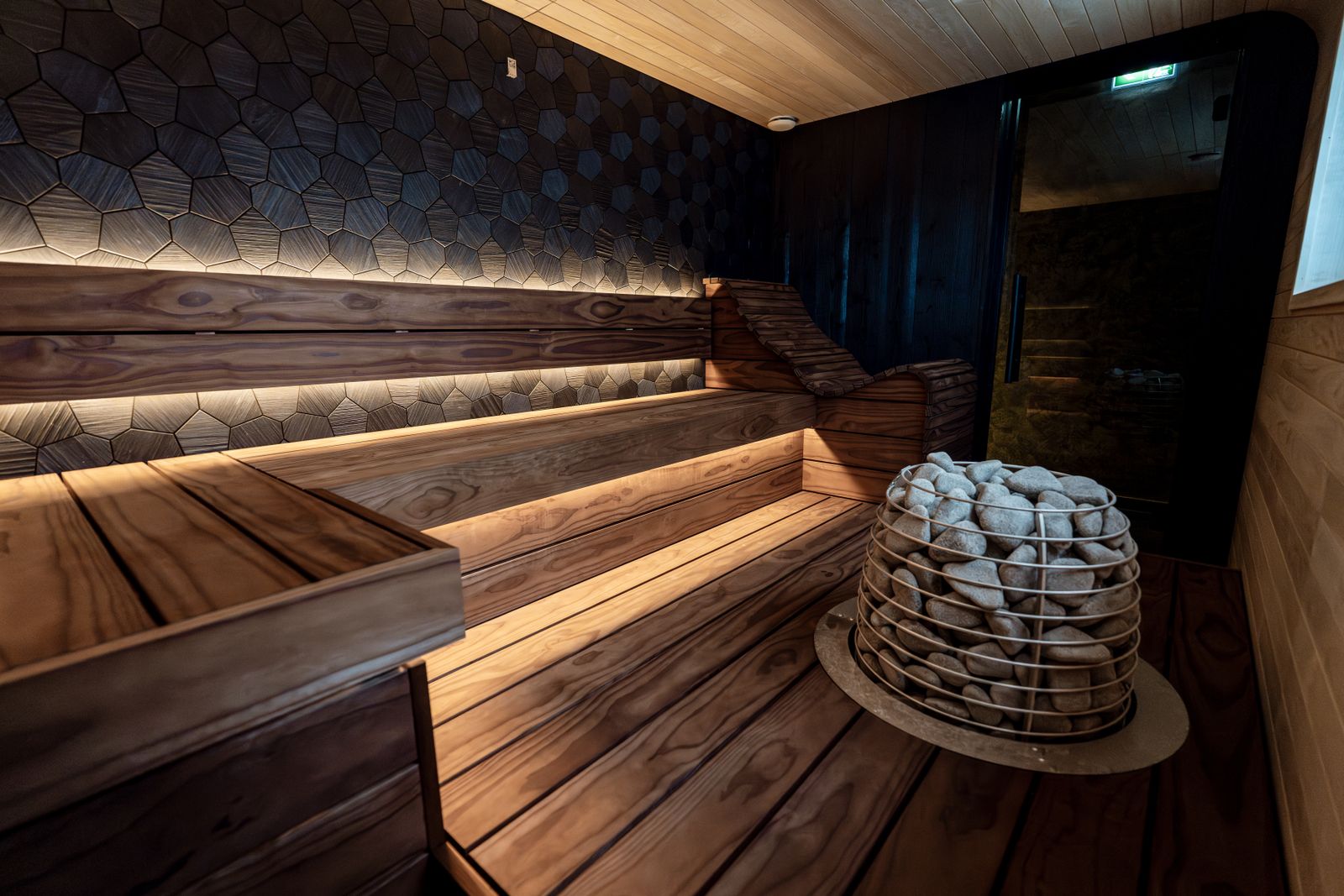
Is a home sauna worth it compared with a public one?
Here we need to be honest. If only the electricity counted, a home sauna would win at first glance: €2.20 an evening against €10–17 per person for entry to a public sauna world. But the equation also includes the purchase price of the cabin and heater, the electrical installation, possibly building work, and then ongoing maintenance — cleaning, replacing the stones, occasionally sanding the benches down, servicing the controls.
| Item | Home sauna (medium cabin) | Public sauna |
|---|---|---|
| Cost per session | approx. €2.20 for the whole cabin (model estimate) | roughly €10–17 per person for entry |
| Purchase cost | a one-off, from low thousands to tens of thousands of euros | none |
| Maintenance and servicing | your concern, on an ongoing basis | included in the entry price |
| Availability | any time, with no travelling and no booking | opening hours, travel time |
| Privacy | complete | limited |
The practical conclusion: if you use a sauna once a month, a public sauna will work out cheaper and is a sensible choice. A home sauna starts to make economic sense from roughly a regular weekly rhythm onwards, and especially when the whole family uses it — there the difference in entry fees adds up fast. Most owners, though, do not buy a sauna for the payback, but because they can climb into it at ten on a Thursday evening with no planning. That does not fit into a table. How to choose a particular type is covered in our article on how to choose a home sauna, and the choice of heat source in our comparison of electric and wood-fired sauna heaters.
And what about an infrared cabin? The less demanding alternative
An infrared cabin is not the same thing as a Finnish sauna — it works at temperatures around 45–60 °C and warms the body with radiant heat rather than hot air. The experience is different, gentler, with no water on the stones. In return it is considerably more modest in energy terms: panel input is commonly around 1.5–2.5 kW and the long phase of heating the whole mass of the cabin and the stones falls away, so a single use works out at something in the order of 20–40 cents rather than a couple of euros.
For a flat, a small space or a lower heat load it is a practical choice — in more detail in our article on an infrared sauna for a flat. But anyone who wants a classic Finnish sauna with the shock of heat and steam will not find an infrared cabin a substitute.
Frequently asked questions
Is it worth keeping the sauna hot between sessions?
Almost never. Holding the temperature means the heater switches on all day long to make up the cabin’s heat losses — in a medium sauna that means many times more energy than a single heat-up. Keeping a sauna warm makes sense only in the exceptional situation where several groups of people follow one another during a single day at intervals of tens of minutes, in a holiday cottage let out to guests, for example. For an ordinary household the rule is: switch off, dry out, close up.
How long does it take to heat a sauna up?
In a well-insulated cabin with a correctly sized heater, reckon on 40–60 minutes to reach 80–90 °C. An outdoor sauna in winter needs considerably longer, easily 70–90 minutes. If your sauna takes substantially longer, look for the cause in an undersized heater, leaky doors, an open ventilation vent or old stones rather than in the weather itself.
Do I have to change the electrical supply for a sauna?
Heaters of 4.5 kW and above are practically always connected to 400 V and a separate protected circuit. That is a job for an electrician with an inspection certificate, not for an extension lead. Before you order a sauna, check the reserved capacity of your house supply — in older houses with a small main breaker an increase may be needed, which also affects the monthly standing charge.
Will a sauna push up my monthly electricity payment?
With one session a week in a medium cabin, our model gives roughly 38 kWh a month, that is about €9.50. With three sessions a week it is already around 115 kWh and approximately €29 a month. At that point it is worth adjusting your monthly payment so that the annual bill does not take you by surprise.
How do I find out my sauna’s real consumption rather than an estimate?
The simplest route is to read the electricity meter before heating up and after drying out, or to use sub-metering on the sauna circuit. After three or four sessions you will have an average that is more accurate for your cabin, your location and your habits than any general calculation — including ours.
In conclusion
The consumption of a home sauna is one of the few items in running a wellness setup that you can work out in advance with reasonable accuracy — all you need to know is the heater output, the heating-up time and the price of your kWh. Treat the figures in this article as a starting model, not as an invoice: the reality will be somewhere else depending on insulation, location and how you use the sauna. The good news is that for the vast majority of households, running costs come out lower than expected before buying.
If you are working out a particular cabin, heater or accessory, take a look at what is on offer in the wellness category, and you will find further texts on saunas, hot tubs and pools in our advice section.
