
Water features turn a pool from a “tank for swimming” into a place where the whole family lingers all afternoon. A cascade massages your neck, an air bench creates a bubble bath like in a hot tub, and a geyser keeps children entertained better than any toy. The key thing to know is that most features need their own pump and wall penetrations — which is why it pays to plan for them while the pool is still being built.
Why add water features to your pool?
The first reason is simple: fun. Children grow bored of a plain pool within a few days, while a geyser or a slide keeps them in the water all summer. For adults, the main draw is massage — a stream of water from a cascade onto the neck and shoulders works much like a massage shower, and after a day at the computer it is one of the most pleasant ways to release tight muscles.
Features also bring a practical side benefit. The falling water from a cascade stirs the surface and helps push floating debris (pollen, insects, leaves) towards the skimmer, which can then catch it before it sinks to the bottom. At the same time, water passing through the air picks up oxygen, which helps keep it fresh.
One “but” is fair to mention: sprayed water evaporates intensively and cools down in the process. In a hot summer this is a welcome natural way to cool an overheated pool, but in spring and autumn a running cascade needlessly wastes the heat you paid for. So run the features while you swim — not around the clock.
What water features are available? An overview
The range stretches from simple jets for a couple of hundred euros to stainless steel cascades and slides costing several thousand. The table sums up the basics.
| Feature | What it does | Who it’s for | What it needs |
|---|---|---|---|
| Cascade (cobra, waterfall) | Falling stream of water, neck and back massage, soothing sound | Adults, garden design | Dedicated pump, approx. 10–25 m³/h |
| Water mushroom | A water “umbrella” for children to hide under | Mainly children | Dedicated pump |
| Side massage jets | Targeted stream of water on the back or lower back, often with air induction | Adults — recovery | Feature pump, wall penetrations |
| Air bench / geyser | Bubble massage — bubbles from the floor or a seating bench | The whole family | Air blower |
| Counter-current unit | Powerful stream for stationary swimming and massage | Swimmers, athletes | Its own 40–75 m³/h pump — separate article |
| Slide | Classic fun for children | Children | Solid anchoring, sufficient landing depth |
| Illuminated features | Cascade or geyser with LED backlighting for evening swims | Aesthetics, evening use | Additional 12 V wiring — see pool lighting |
Cascade, cobra and water mushroom — decoration and massage in one
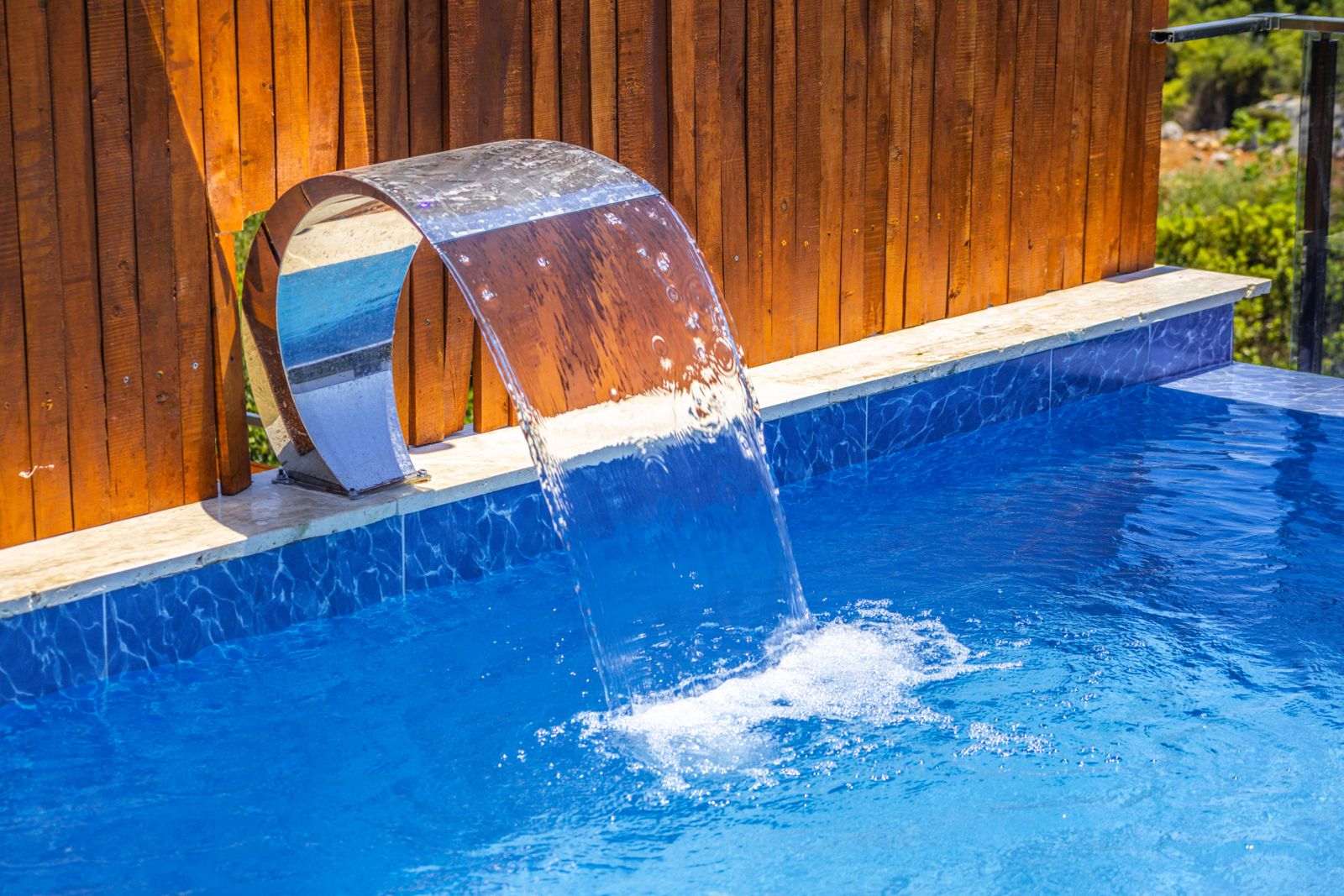
Cascades are the most popular feature of all because they play two roles at once. A stainless steel arc or “cobra” at the pool edge looks architecturally clean and doubles as a massage element — just stand under the falling stream and let it work on your neck and trapezius muscles. The water mushroom is the children’s version: water flows down over the cap like a curtain, creating a hideout children love.
Side massage jets — targeted hydromassage
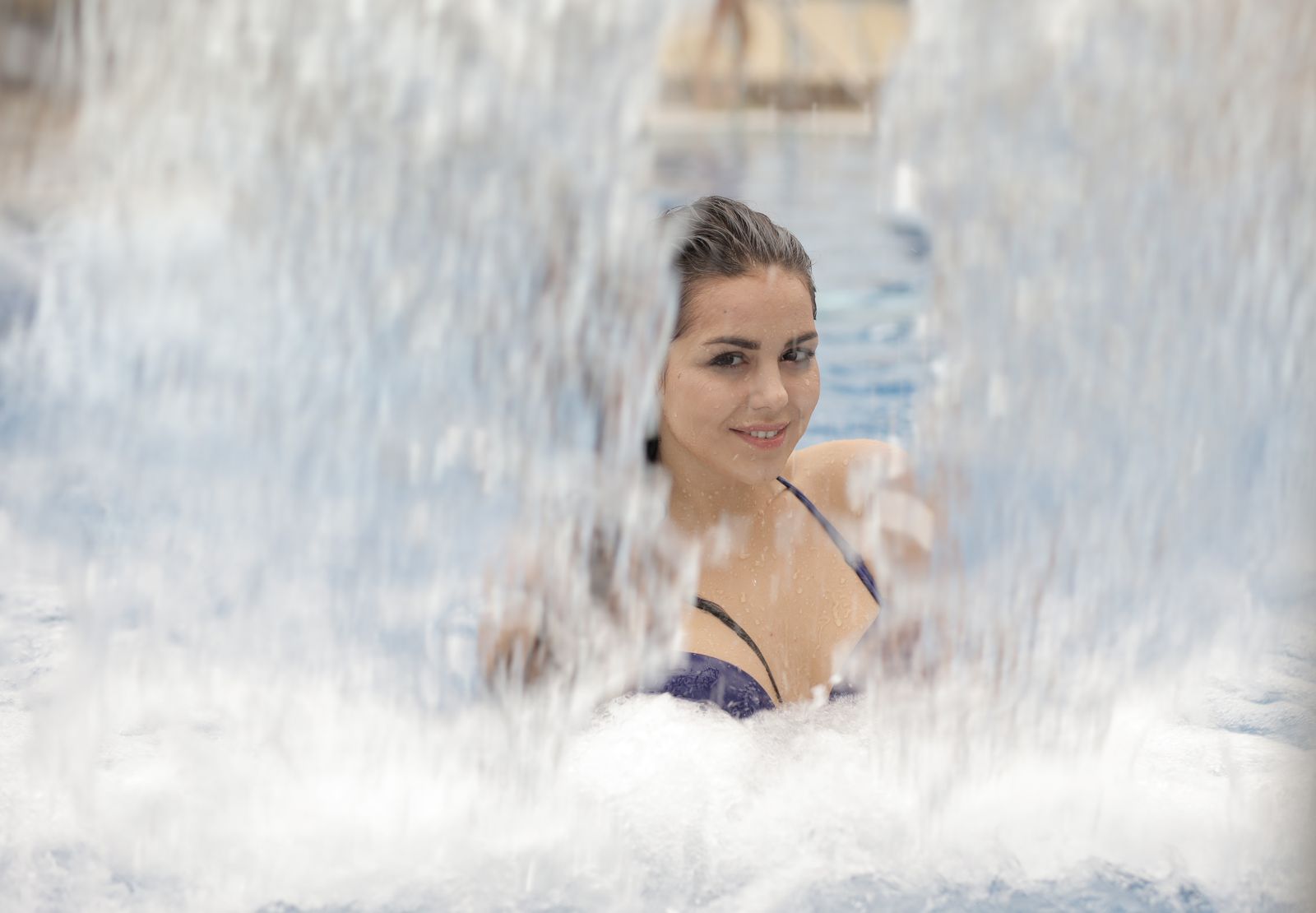
Jets built into the pool wall work on the same principle as in a hot tub: a stream of water, often enriched with induced air, targets specific areas — the back, lower back, calves. Two to four jets are usually installed side by side near a seating bench or the steps, so you can stand or sit at them comfortably.
Air bench and geyser — a bubble massage from below
Air features work with air rather than water: a powerful blower pushes air into a perforated bench or a floor grid, and it rises as thousands of tiny bubbles. The result is a gentle full-body bubble massage — the closest you can get to a hot tub experience in a pool. A floor geyser is also an eye-catching toy for children and a striking visual element.
Counter-current unit and slide
A counter-current unit is a category of its own — primarily a sports device for stationary swimming, secondarily the strongest massage stream in the pool. We cover power selection, installation types and prices in detail in the article Pool counter-current units. A slide is a purely fun element: allow for the space it needs around the pool, solid anchoring into concrete and a safe depth at the landing point.
What do water features need technically?
This is where satisfaction is decided. The most common mistake is connecting a cascade or jets to the existing filtration circuit “to save money”.
A dedicated pump, or a connection to the filtration?
The filtration pump is sized to push water through the sand bed slowly and evenly — typically 8–12 m³/h for a family pool. An impressive cascade, however, needs 10–25 m³/h all to itself. Hang it on the filtration and you get a feeble trickle instead of a stream, and if the flow is sufficient, water rushes through the filter too fast and degrades filtration quality. That is why practically all water features except the smallest ones need their own pump with its own suction, switched on only while you swim.
A blower for air features
The air bench and geyser do not need a water pump but a blower — an air compressor rated typically at 0.7–1.5 kW. It is mounted above the water level or protected by a check valve so that water cannot flow back into it after switch-off. The blower is also the main noise source of the whole setup — more on that below.
Wall penetrations: plan during construction, or retrofit?
Every jet, suction point and cascade feed means a penetration through the pool wall and pipework running to the plant room. With a concrete or liner pool, it is incomparably cheaper and more reliable to install the penetrations during construction — even if you only buy the feature itself two years later, preparatory pipework for a few hundred euros keeps that door open. Retrofitting means demolition work, new waterproofing around the penetrations and often cutting into the liner; realistically it only pays off combined with a larger renovation of an old pool, when the liner is being replaced anyway. The exceptions are hang-on cascades for the pool edge and features connected by a hose over the wall — those can be added at any time.

How are the features controlled?
The simplest and most widespread solution is a pneumatic button: a mechanical button built into the pool coping that switches the pump relay via an air hose. It is completely safe (no electricity near the water), so you can switch the feature on straight from the water without walking to the switchboard.
The next level up is connecting the features to pool automation — you then switch the feature pumps and blower from a mobile app or by voice, set time limits (for example an automatic shut-off after 15 minutes) and the features become part of scenes together with the lighting. We describe everything smart pool technology can do in our article on pool automation.
What to consider before buying?
Noise. The feature water pump is about as loud as the filtration pump, but the blower is considerably more audible — it is a high-speed air blower. Place it in a plant shaft or plant room as far as possible from the terrace and bedroom windows, ideally on an anti-vibration pad. An evening bubble bath with a roaring compressor two metres from your lounger loses its magic.
Power consumption. A feature pump typically draws 0.5–1.5 kW, a blower 0.7–1.5 kW. Unlike the filtration, though, they only run for tens of minutes a day while you actually swim — an hour of cascade operation therefore costs roughly €0.20–0.60 depending on electricity prices. So the features add only modestly to running costs; the bigger item is the water cooling mentioned above when a cascade runs for long periods.
Winterizing. Features are full of pipework, and frost will burst it just as readily as the filtration circuit. Before winter you need to drain the water from the feature pump, jets and feed lines, blow out the pipes or protect them with anti-freeze plugs, and disconnect the blower and store it somewhere dry. You will find the complete procedure in our guide to winterizing your pool step by step.
How much do water features cost?
Prices vary with material (stainless steel vs. plastic) and power, but as a rough guide budget for the following amounts including VAT; installation and pipework are added depending on scope:
| Item | Indicative price |
|---|---|
| Stainless steel cascade / cobra | €400–1,800 |
| Water mushroom | €600–2,000 |
| Side massage jet (complete, per piece) | €80–240 |
| Feature pump | €320–1,000 |
| Blower + air bench / geyser | €600–1,600 |
| Slide | €600–3,200 |
| Pneumatic button with relay | €80–160 |
The cheapest ticket into the world of water features is a single side jet connected to a smaller pump — a complete setup comes to roughly €480–800. At the other end, a stainless steel cascade with its own pump, backlighting and a connection to the automation easily exceeds €2,400.
Frequently asked questions
Can water features be added to a finished pool?
Partly, yes. Hang-on cascades for the pool edge and some features with a hose connection can be added without demolition work. Wall jets, an air bench or a water mushroom with floor penetrations, however, require construction work — best tackled when the liner is being replaced or during a full pool renovation.
Does a cascade help keep the water clean?
Indirectly, yes: the stirred surface pushes floating debris towards the skimmer and the water gets oxygenated. But it does not replace filtration or water chemistry — it is a bonus, not a reason to buy.
Why can’t a feature run off the filtration pump?
The filtration pump is designed for a slow flow through the filter. A feature needs a large flow of water for short periods — connected to the filtration, the effect will be weak and the fast flow through the sand will degrade filtration quality. A dedicated pump costs more to buy, but it is the only correct solution.
How loud is an air bench?
The bubbling itself is pleasant; the noise source is the blower — comparable to a powerful vacuum cleaner. Placement decides: in an enclosed plant shaft further from the pool, you will barely hear it while bathing.
Do the features have to be winterized?
Yes, always. Water frozen in the pipework, a jet or the feature pump means cracked parts in spring. The pipes are drained and blown out just like the filtration circuit, and the blower is disconnected and stored somewhere dry.
Whether you start with a single massage jet or go straight for a stainless steel cascade with automation, the foundation is the same: a quality pump, well-planned penetrations and controls you will enjoy using. You will find cascades, jets, blowers and complete counter-current units in our pool technology category — and if you are unsure about sizing, browse the other guides in our Advice centre.
