
Leaves, pollen and drowned insects are not just a cosmetic nuisance — they are organic contaminants that consume disinfectant, bring phosphates and nitrogen into the water (in other words, food for algae) and clog the filtration. Anyone who only picks them out once the surface is “full” ends up working more and paying for chemicals twice over. The text below shows when each type of debris arrives, which technique removes it fastest, and what can eliminate most of the work once and for all.

Why organic debris does more damage than it looks
Every leaf, every grain of pollen and every fly is an organic load on the pool. Chlorine (or bromine, or active oxygen) tries to oxidise it and is consumed in the process — so water that has had leaves fall into it shows a lower free chlorine level a few hours later, even though you did nothing wrong. A typical symptom: on Monday you measure 0.3 mg/l even though you dosed by the book on Friday.
The second problem is phosphates. Decomposing plant matter, pollen and sunscreen residues add phosphates and nitrogen compounds to the water — precisely what algae grow on. Green water after a rainy, windy week is no coincidence; it is the result of an organic load plus depleted disinfectant. What to do once it has happened is covered in the article Green pool water.
The third and least reversible problem is liner staining. Leaves (especially oak, chestnut and walnut) contain tannins and natural pigments that leach out of a resting leaf into the material. If a leaf sits on the bottom of a light-coloured liner overnight, usually nothing happens. If it lies there for a whole week, or all winter under a cover, it leaves a brown silhouette that no chemical will reliably remove. The same applies to rust marks from metal objects and to dark algae traces in the pores of concrete.
Last in line comes the equipment: sucked-in leaves clog both the skimmer basket and the pump pre-filter, flow drops, the pump runs against resistance and heats up. A blocked basket is one of the most common causes of “the filtration isn’t working” reports and of unnecessary service call-outs.
A seasonal calendar of debris: what arrives when
Debris is not the same all year round and cannot be handled with the same tool. Breaking the season down helps you have the right accessory ready before the problem arises.
Spring: pollen, seeds and windblown debris
April to June is the season of pollen from birch, pine, alder and grasses, followed by seeds (maple “helicopters”, poplar fluff) and the first swarms of small insects. Pollen is the most insidious of all because it is extremely fine — it forms a yellow-green film on the surface that a net will not catch and that ordinary filtration largely passes straight back into the pool.
Summer: insects, lotions and bather load
In summer there are more drowned insects (wasps, flies, beetles), but above all more organics from bathers — sunscreens, body lotions, sweat and cosmetics. These bind with the disinfectant into compounds that cause cloudiness, a film on the surface and the characteristic “pool” smell. In a hot tub the same effect shows up even faster and more strongly, see Foam and smell in a hot tub. The prevention is trivial and effective: shower before bathing and apply sunscreen at least 20 minutes in advance.
Autumn: leaves on a large scale
From late September, leaves are the main enemy — and they remain so after the season has ended. Leaves that land on the cover and get into the water during winterising then sit there for five months and stain the liner. That is why a pool is not only treated chemically before winter but also thoroughly vacuumed and covered so that nothing can get underneath. The complete procedure is described in the guide Winterising your pool step by step.
Tools and technique: how to collect faster and more effectively
Two nets, not one
The classic mistake is a single all-purpose net. In reality you need two: a flat fine skimmer net for the surface (low frame, dense mesh, catches pollen and small insects) and a deep coarse net for the bottom (large bag, collects leaves that have already sunk). A flat net does not work on the bottom, and a deep one pushes a wave ahead of it across the surface.
Technique matters more than strength. The rule is the slow pull: guide the net smoothly just below the surface at roughly the speed of a slow walk, never with a sweeping motion. A sharp movement creates a pressure wave that drives the debris away and stirs up settled fine sediment, so you end up with cloudiness to deal with as well. On the bottom, move the net in one direction with overlapping passes and empty the raised net outside the pool — not by shaking it out over the water.
The skimmer and its basket
The skimmer cleans the surface for you, but only as long as it has flow. Empty the basket according to the season: in summer every two to three days, in autumn quite possibly daily. A full basket means the skimmer stops drawing off the surface and debris begins to settle on the bottom — and the pump draws against resistance. Always check the pump pre-filter as well, where anything the basket lets through ends up. The difference between skimmer and overflow designs and their maintenance demands is discussed in the article Skimmer vs. overflow pool.
The skimmer sock: the cheapest accessory of the season
A skimmer sock is a fine mesh sleeve that you stretch over the skimmer basket. For a couple of euros it catches pollen, fluff, fine dust and small insects that would otherwise slip through into the filter. During the pollen season it is the single most effective measure there is. The downside: it clogs quickly, so in pollen season it should be checked daily and washed or replaced once it blocks up.
Vacuum and robot
Manual vacuuming handles the bottom reliably, but with a pool surrounded by trees it is an hour of work a week. An automatic robot takes that over — modern models with their own filtration and a large basket cope with leaves and also clean the walls and the waterline. The selection criteria (basket size, brushes, cable vs. battery, waterline cleaning) are compared in the guide How to choose a pool vacuum and robot. For a pool under trees, choose a model with the largest possible filter basket — otherwise you will be cleaning it twice per cycle.
Prevention: covering the pool is the biggest labour saver
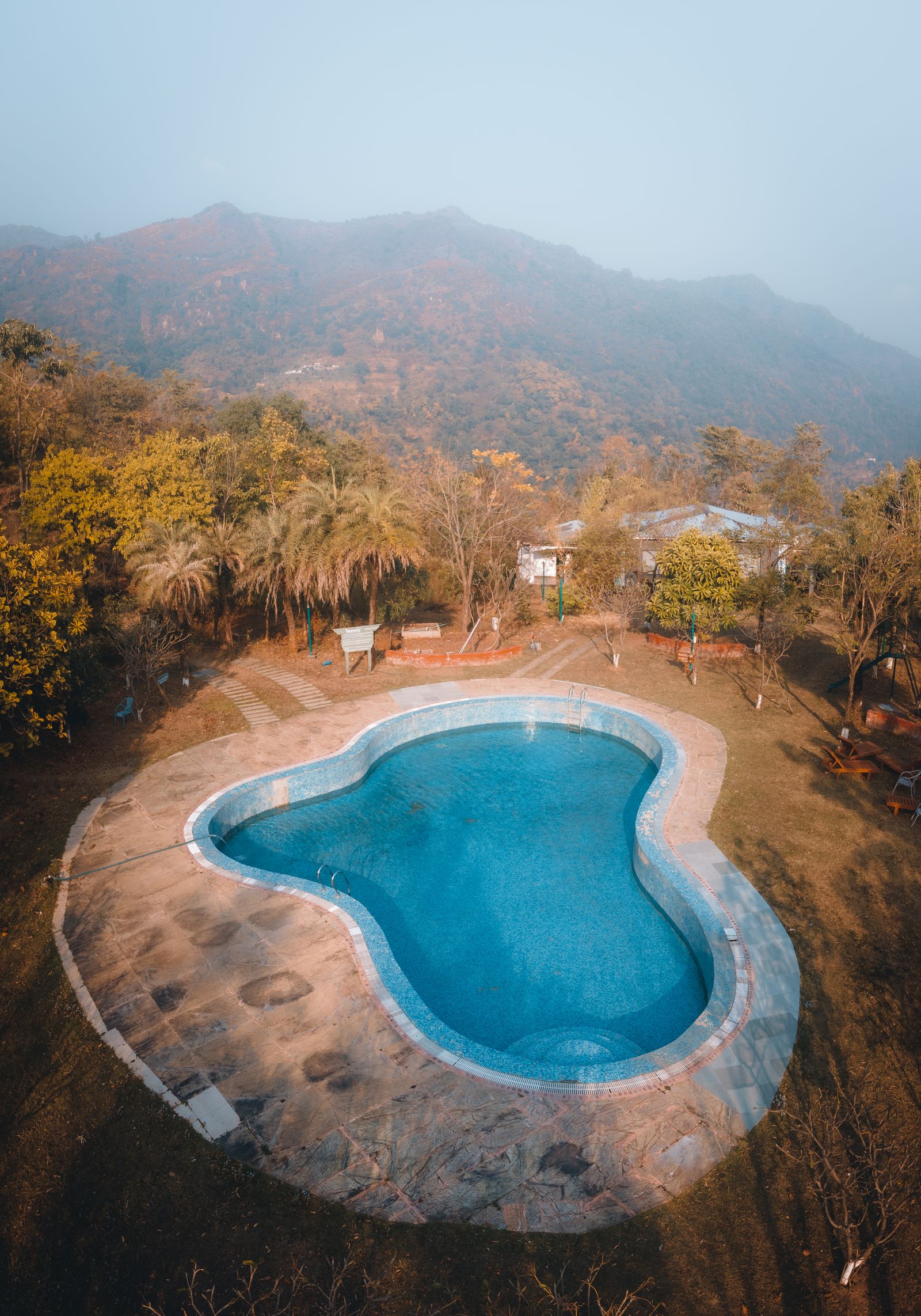
No net can match simply keeping the debris out of the water in the first place. Covering the pool when it is not in use reduces the amount of debris that falls in by an order of magnitude — and at the same time limits evaporation, heat loss and chemical consumption. A solar cover mainly helps against dust, pollen and heat loss; a solid safety cover or an enclosure also deals with leaves, branches and safety. The differences between cover types and their benefits are discussed in the article Pool enclosures and solar covers.
The other half of prevention is the garden. Before planting near a pool, a few rules apply:
- Do not plant deciduous trees with small leaves right next to the pool (birch, willow, maple) — small leaves are harder to collect and easily pass into the skimmer.
- Avoid species with strong pigments and fruit — walnut, oak, chestnut, mulberry, berry bushes. Tannins and fruit juice stain both the liner and the joints.
- Beware of conifers: needles clog baskets, pines also release pollen on a massive scale and resin is hard to remove.
- Choose evergreen and low shrubs at a distance of at least 3–5 metres, ideally with mulch instead of lawn (mown grass in the wind is a classic source of debris).
- Use a windbreak: a low fence, a dense hedge or a wall of ornamental grass on the prevailing wind side will catch a large share of light debris before it reaches the water.
When planning a new pool, siting carries more weight than any accessory added later. A pool on the windward side of the plot beneath tree canopies will always be more work than a pool in a paved, partly sheltered part of the garden. The compromise between shade and cleanliness can be solved with a pergola or a canopy instead of trees — see A pool in a small garden.
Pollen: why it passes through the filter and what to do about it
Pollen grains are roughly 10–100 micrometres in size. A sand filter with standard media reliably captures particles from about 30–40 micrometres upwards — so finer pollen flows straight back into the pool and the filtration seems “ineffective” even though it is working correctly. A cartridge filter is finer, but clogs faster.
The solution is to make the particles bigger so the filter can catch them. That is what a flocculant is for: in liquid or tablet form it binds fine debris into larger flocs. Liquid flocculant is dosed into the skimmer with the filtration running, tablets go into the skimmer basket. The procedure for heavy pollen:
- Adjust the pH to the 7.2–7.6 range — outside it, flocculation does not work well.
- Dose the flocculant according to the instructions and run the filtration continuously for 8–12 hours.
- Let it settle (with heavy cloudiness, even overnight with the filtration off) and vacuum the sediment to waste, not through the filter.
- Backwash the filter and then run briefly to waste (rinse).
Backwashing is precisely what matters most in pollen season — the filter clogs far faster, which you will notice from the rising pressure on the gauge. Which valve positions are used for what, and in which order, is explained in the article The multiport valve on a sand filter. It also helps to watch the pressure using the pressure gauge: a rise of 0.3–0.5 bar above the clean state is the signal to backwash.
Insects around the pool: wasps, mosquitoes and drowned bodies
Wasps and hornets come to the water to drink, mainly on hot August days. The pool itself does not attract them — what attracts them is sweet drinks, fruit and the bin on the terrace. The most effective measure is therefore to move the food sources further away and offer an alternative drinking spot (a shallow dish with stones) in a more remote part of the garden. Do not use chemical sprays near the water; they will end up in the pool.
Mosquitoes cannot lay eggs in a functioning pool — circulating chlorinated water is unusable for larvae. The trouble comes from standing water around it: hollows in a folded cover, puddles in the roller shutter, watering cans, rainwater butts and blocked gutters. Emptying the water out of the cover and the watering cans once a week gets rid of mosquitoes more reliably than any product.
Drowned insects should be lifted out with a fine net daily. The bodies decompose quickly in water, consume disinfectant and, in larger numbers, contribute to cloudiness. When a large number of small insects appears all at once (typically after a warm evening with the lights on), it helps to redirect the lighting: strong white light at the surface attracts insects far more than warm shades or lighting aimed into the water.
Overview: problem → tool → prevention
| Debris | Season | Tool for removal | Most effective prevention |
|---|---|---|---|
| Leaves on the surface | September–November | Flat fine net, skimmer | Cover or enclosure, trees 3–5 m away |
| Leaves on the bottom | September–November | Deep net, vacuum, robot with a large basket | Daily surface skimming — what does not sink cannot stain the liner |
| Pollen and fluff | April–June | Skimmer sock, flocculant, frequent backwashing | Covering overnight, windbreak, choice of trees |
| Seeds and grass | May–July | Fine net, skimmer basket | Mulch instead of lawn by the pool, mow away from the pool |
| Drowned insects | June–September | Fine net daily | Sweet drinks away from the terrace, warm lighting |
| Mosquito larvae | June–August | Remove standing water nearby | Empty hollows in the cover and the roller shutter |
| Lotions and surface films | June–August | Absorbent sponge, shock disinfection | Shower before bathing, sunscreen 20 minutes in advance |
| Tannin stains | all year | Spot cleaning, stain remover | Never leave leaves lying on the bottom overnight |
A routine that takes five minutes a day
The cheapest maintenance is the short, regular kind. A proven rhythm looks like this:
- Daily (2–5 minutes): run the fine net across the surface, glance at the skimmer basket.
- Twice a week: empty the skimmer basket and the pump pre-filter, measure pH and disinfectant.
- Weekly: vacuum the bottom (or send in the robot), check the filter pressure, backwash if needed.
- Seasonally: fit a skimmer sock in spring, shorten the daily cycle in autumn, clean the bottom thoroughly before covering.
Stick to this rhythm and you collect little and briefly. Skip it and you collect for a long time — and have to sort out the chemistry as well. A year-round, month-by-month overview of the tasks can be found in the article Pool maintenance calendar.
Frequently asked questions
How often should I collect leaves to keep the liner from staining?
Ideally daily, at least every other day. What matters is that a leaf does not lie on the bottom for more than 24–48 hours — after that, tannins start to be released and penetrate the material. Light-coloured liners are more sensitive than dark ones, and concrete pools are more resistant than liner pools.
Does increasing the filtration time help against pollen?
Partly. Longer filtration increases the number of turnover cycles, but the finest pollen grains pass through a sand filter anyway. The combination that works: a skimmer sock on the basket, a flocculant to bind the particles together, and then a backwash. Simply running the pump for longer only increases electricity consumption.
Do I need to adjust the chemistry after a fall of leaves?
Yes — at the very least check it. A larger amount of organics lowers the free chlorine level and may shift the pH. After a heavy load (a storm, strong wind, falling leaves) test the water and dose if needed — not waiting for cloudiness is cheaper than dealing with it afterwards. The effect of rain and storms is covered in more detail in the article Rain and storms: what to do with pool chemistry.
Is a robot worth it if my pool is under trees?
Usually yes, but with one condition: it must have a large filter basket and a sturdy build, otherwise it will choke on leaves halfway through the cycle. A robot does not replace skimming the surface with a net — it works mainly on the bottom and the walls. The most effective combination is a cover plus a robot plus a short daily pass over the surface.
Is a skimmer sock suitable all year round?
It is not necessary all year. It makes the most sense during the pollen season (April–June) and during heavy leaf fall. At other times it needlessly reduces the flow, so it is enough to take it off and simply check the ordinary basket.
Surface maintenance is a discipline where the system wins, not the effort. Covering the pool, sensibly chosen greenery around it, two proper nets and a skimmer sock in pollen season will cut the time spent at the pool to a few minutes a day — and at the same time save the disinfectant you would otherwise use up breaking down organics. Nets, skimmer socks, vacuums, flocculants and spare baskets can be found in the Pool maintenance category, and supporting equipment in the Technology section. More practical guides are available in the other Guide articles.
