
A slatted cover is a pool cover that winds onto a shaft at the edge of the pool and closes the entire water surface at the touch of a button. It solves three problems at once that would otherwise need three separate solutions: it cuts evaporation and heat loss, keeps leaves and insects out of the water and, when properly specified, works as a safety barrier. It charges more than a floating cover and less than an enclosure — in 2026, standard above-water slatted covers start at roughly €2,000, while below-water versions exceed €8,000. This article explains how a slatted cover works, when to choose an above-water and when a below-water system, which slats make sense and where the real pitfalls lie.
How does a slatted cover work?
The principle is simple, and that is exactly its strength. The individual slats — hollow profiles with sealed chambers — are linked together into a continuous belt wound onto a shaft. The shaft turns, the belt unrolls and floats on the surface, because the air in the chambers gives it buoyancy. On a typical family pool, closing or opening takes two to four minutes.
Operation can be manual (with a crank or lever), motorised at 230 V with a safety transformer, or motorised with a solar panel, where the panel charges a battery and no mains supply to the shaft is needed. The manual version is the cheapest and virtually fault-free, but on a pool longer than 8 metres the cranking becomes annoying enough that the cover stops being used — and a cover that is not used saves nothing.
The ends of the winding shaft sit in bearing units that are either anchored to the pool coping (above-water version) or sunk below the waterline in a so-called niche — a transverse recess inside the pool. Choosing between these two approaches is the main decision point of the whole investment.
Above-water or below-water cover?
The difference is not only aesthetic. A below-water cover has to be planned at the moment the pool is being drawn — the niche takes up length and changes both the structure and the hydraulics, much as an overflow pool requires the balance tank to be resolved in advance (we cover the differences in the article Skimmer vs. overflow pool). An above-water cover, by contrast, can be added at practically any time.
| Criterion | Above-water cover | Below-water cover (niche / dry shaft) |
|---|---|---|
| Indicative price incl. installation (2026) | €2,000–6,000 | €6,000–15,200 (plus building work) |
| Appearance | Visible shaft and supports at the pool edge | Completely hidden, nothing visible once opened |
| When the decision is made | Any time, even on a finished pool | Must be planned before construction |
| Loss of pool area | None (the shaft sits above the water or beyond the edge) | The niche takes roughly 0.6–1.0 m off the length |
| Access to the mechanics | Easy, everything within reach | A wet niche means draining part of the water; a dry shaft gives good access |
| Maintenance demands | Low | Higher — the niche collects debris and needs its own filtration or jet |
| Space around the pool | Requires a clear strip of about 0.5 m along one wall | The pool surround stays clear |
| Suitable for | Retrofits, budget-conscious projects | New builds, design gardens, indoor pools |
Below-water covers split further into two sub-variants. A wet niche is a recess directly in the water, separated from the pool by a grating or a bench — cheaper and by far the most common. A dry shaft is a separate, watertight compartment behind the end wall; the motor and the winding shaft stay out of the water, which extends their life and simplifies servicing, but the price and the building requirements go up.
Which slats should you choose?
The slat material affects the purchase price by almost a factor of two, and the practical value even more.
PVC slats
The most widespread and cheapest option. Opaque, usually in white, grey, blue or sand. They reliably prevent evaporation and heat loss, they are light and resistant to chlorinated water. The drawbacks are lower resistance to mechanical damage (hail) and to overheating — if a PVC slat lies in the sun out of the water for a longer time, it can deform. That is precisely why above-water covers, where the wound belt stays in the open air, are fitted with a shaft cover.
Solid polycarbonate slats
Polycarbonate tolerates a wider temperature range and offers far better impact resistance — quality PC slats are declared to keep working even after being hit by hailstones around 5 cm across. They usually come in transparent, smoked or pearl finishes, and the pool beneath them looks less “wrapped up”. The price is tens of per cent higher than PVC.
Solar polycarbonate slats
The transparent upper chamber lets sunlight through, while the underside of the slat has a dark absorbing layer that passes the heat to the water. The effect is noticeable: according to manufacturers’ figures and experience from the French market, where slatted covers are the standard, a closed cover raises the water temperature by roughly 4–6 °C compared with an uncovered pool. Solar slats are made almost exclusively from polycarbonate — PVC would deform in the heat.
Watch out for one limitation: solar slats need sunlight reaching the water surface. On an indoor pool, or a pool shaded by the house and trees, you pay a premium for a function that will never show. There, a plain white PVC slat makes more sense and the money is better invested in heating.
What does a slatted cover actually deliver?
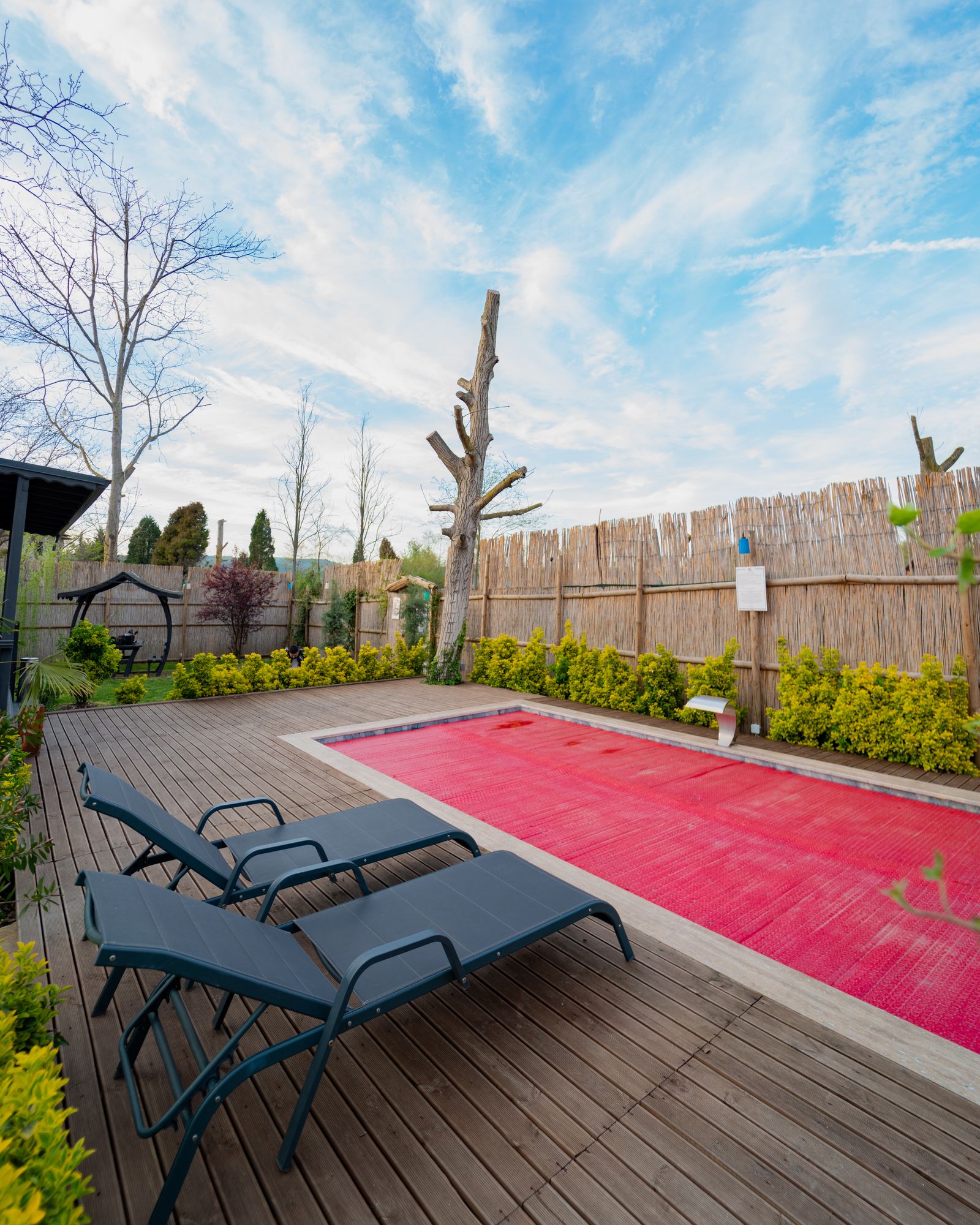
Less evaporation and lower heat loss
An open water surface loses heat mainly through evaporation — and evaporation is by far the largest item in the energy balance of an outdoor pool. A covered surface suppresses evaporation by something like 80–90 %, which shows up both in the energy used for heating and in the water topped up. We look at the physical principle and the specific figures in detail in the article on the solar cover and pool covering; a slatted cover works on the same basis, only more conveniently and with a longer service life.
The practical consequence: in the shoulder months, a slatted cover often decides whether the water is 24 °C or 20 °C in the morning.
Far less debris in the water
A closed cover holds back leaves, pollen, dust and most insects. The filtration has less work, the skimmer basket does not fill up every day and chemical consumption drops, because no organic material falls into the water to consume the disinfectant. We summarise what ends up in a pool and how to fight it even without a cover in the article Leaves, pollen and insects in the pool.
One necessary note: the debris that lands on the cover stays there. After an autumn storm you need to sweep or rinse the belt before opening it — otherwise you tip the lot into the water at once.
A safety function — but only when the cover really has one
This is the point where most mistakes are made. Not every slatted cover is a safety device. To be one, it has to be built and anchored so that a child cannot walk across the closed surface and fall through it.
The reference standard is the French standard NF P90-308, which applies in France, where it is one of four legally recognised ways of securing a private outdoor pool. It mainly defines:
- the cover must prevent a child under 5 years of age from entering the water;
- it must withstand the fall of an adult weighing 100 kg without tearing;
- between the anchoring points it must not lift by more than 10 cm, so that nobody can slip underneath;
- the anchoring points must resist a 50 kg impact and must not form dangerous spikes above the edge;
- on motorised covers the controls must be out of children’s reach (usually above 1.25 m), with a direct view of the pool while closing;
- the installing company issues a declaration of conformity.
Requirements differ from country to country — NF P90-308 is a French standard and applies in France; in the Czech Republic, for example, no comparable duty exists and securing a private pool is left to the owner, while other countries have rules of their own, so always check the legislation in force where you live. That does not mean the standard is worthless: it is the only concrete yardstick by which you can tell whether a supplier is making things up or not. Ask about certification of the specific assembly (slats + side guides + anchoring), not just about phrases along the lines of “it will hold a child”. And expect a certified version to cost 10–20 % more.
Even a safety cover is no substitute for supervision. You will find the wider context and the other elements — alarms, fencing, rules at the water — in the article Child safety around the pool and hot tub.
What to watch out for before ordering
- Flatness and geometry of the edge. A slatted cover is unforgiving of inaccuracies. A pool whose width varies by several centimetres over 8 metres of length means a belt that winds crookedly and rubs against the guides. Have the pool measured up before ordering — not read off the drawings.
- Space for the winding shaft. An above-water cover needs a clear strip along one wall, typically around 40–60 cm depending on the diameter of the wound belt. If you are planning steps, loungers or a swim jet there, resolve it all together.
- Snow load. Leaving the cover closed through the winter under a layer of wet snow is the most common route to damaging it. Slats are not a load-bearing structure in the winter sense — in winter the cover is normally wound up and protected with a lid, or the pool is dealt with according to the procedure in the article Winterising a pool step by step.
- Waterlogged slats after some years. The buoyancy of the slats comes from the air in the chambers. When an end plug cracks or a weld fails over time, the chamber fills with water, the slat sinks and the belt winds less well. This is the most typical fault after 8–12 years of operation and it is fixed by replacing individual slats — so ask whether the manufacturer still supplies them separately years later.
- Anchoring and structural loads. The supports of an above-water cover transfer considerable forces into the pool coping. Liner and modular pools need reinforcement, and with paving around the pool you have to leave out the anchoring positions — we describe how this ties in with the surroundings in the article Pool surround: paving and decking.
- Electrical installation. A motor near water means safety extra-low voltage, the right residual current device and, above all, connection into the equipotential bonding system. This is neither a formality nor an item to economise on — we explain what has to be bonded and why in the article Pool bonding and earthing.
Maintenance and service life
In terms of care a slatted cover is undemanding, but not maintenance-free. The basics are simple:
- Rinse the belt roughly once a month and always after a storm or a dusty spell — otherwise dirt dries on the slats and forms a film.
- Do not close the cover after shock disinfection. A high chlorine concentration under a closed surface puts needless strain on the slats; let the water vent for 12–24 hours.
- Check the side guides and bearings at the start and end of the season, and lubricate them as the manufacturer instructs.
- Watch whether the belt floats unevenly — a single sinking slat is a warning sign of waterlogging.
The service life of quality slats is around 10–15 years, with polycarbonate towards the upper end; the mechanics (motor, bearings) usually last longer and can be serviced. The logic of care is the same as with a solid enclosure — you will find an overview of the seasonal tasks in the article Pool enclosure maintenance.
How much does a slatted cover cost in 2026?
Prices are driven mainly by the length of the pool, the slat material and whether it is an above-water or a below-water system. Indicative ranges for a pool of roughly 8 × 4 m:
| Version | Indicative price incl. installation | Note |
|---|---|---|
| Above-water, manual operation, PVC slats | €2,000–3,600 | The cheapest entry, inconvenient on longer pools |
| Above-water, motorised, PVC slats | €3,200–6,000 | The most common choice for a retrofit |
| Above-water, motorised, solar PC slats | €4,400–8,000 | The premium only pays back on a sunlit pool |
| Below-water in a niche, motorised | €6,000–11,200 | Building preparation required |
| Below-water in a dry shaft, premium version | €8,000–15,200 | The best appearance and service access |
The figures are based on Czech suppliers’ price lists and on the French market, where above-water motorised covers run around €3,000–6,000 and below-water versions between €6,000 and €15,000 including installation. Treat them as a budgeting framework, not as a quotation — the actual price always depends on the size, shape and accessibility of the pool.
When does an enclosure make more sense than a slatted cover?
A slatted cover and an enclosure are not competitors on the same pitch. A cover works with the water surface, an enclosure with the whole space. The choice is simple once you ask a single question: do you want to swim in cold or rainy weather too?
- The enclosure wins if you genuinely want to extend the season to April–October, swim in rain and wind, protect the pool from leaves off mature trees or have a warm space by the water. Types, heights and requirements are covered in the article How to choose a pool enclosure.
- The slatted cover wins if you want a garden without a bulky structure, if your priorities are heat, cleanliness and safety, if the pool sits in a clean garden without large trees, or if the pool is part of an architectural scheme where an enclosure would jar.
- The floating cover wins on budget — but at the cost of handling. You will find a comparison of the individual types of cover in the article Pool covers: types and how to choose.
In practice, on well-equipped pools you also come across a combination: a below-water slatted cover as the everyday cover and a low enclosure for the cold months. That, however, is an investment that makes sense mainly on a pool used all year round.
Frequently asked questions
Will a slatted cover hold an adult?
A certified safety cover to the French NF P90-308 standard must withstand the fall of a person weighing 100 kg without tearing, but it is not a surface intended to be walked on. A standard cover without certification has no guaranteed capability of this kind. Never walk on a covered pool and never let children do so.
Can a below-water cover be retrofitted to a finished pool?
Generally not without major rebuilding. The niche requires the structure to be deepened and the hydraulics to be redesigned, so it is only done retrospectively during a complete renovation. On a finished pool the usual route is an above-water cover, or a version with the winding shaft hidden under a bench or under the decking.
Does a slatted cover replace a winter cover?
No. Over the winter it is best to wind the cover up and protect it, because wet snow and ice damage both the slats and the mechanics. A winterised pool is protected with a winter cover and floating compensating elements against ice pressure.
How much does a slatted cover warm the water?
Solar polycarbonate slats on a sunlit pool typically add 4–6 °C compared with an uncovered surface. Opaque PVC slats do not heat the water actively, but they prevent night-time cooling through evaporation — which in terms of the overall balance is often worth just as much.
How long does closing and opening take?
On a family pool up to 10 metres long, usually 2–4 minutes. Speed and simplicity are precisely why a slatted cover, unlike a floating cover, really is used every day — and only a cover used every day delivers the promised savings.
In conclusion
A slatted cover is the solution for an owner who wants the pool to run itself and not look like a piece of technical infrastructure. The best ratio of benefit to price comes from a motorised above-water cover with quality slats; the below-water version is a question of appearance and budget that has to be decided before construction. The key is not to underestimate three points: precise measurement of the edge, certified anchoring if the cover is to perform a safety function, and honest electrical work.
If you are working out what to add to the pool first — a cover, steps, lighting or cleaning equipment — you will find an overview of the available extras in the pool equipment category. We keep adding further comparisons and guides to the Guide section.
